

Resilience is one of those words we hear often in education, health, social care and child development. It is used in school improvement plans, wellbeing policies, funding applications and intervention reports. But what do we mean when we talk about resilience in children? And perhaps more importantly, how do we know when resilience is growing?
At Nature Nurture, we understand resilience as much more than a child’s ability to “cope” or “bounce back”. Resilience is not about making children tougher, more compliant, or better able to tolerate difficult circumstances. It is about creating the right conditions for children to feel safe, connected, capable and hopeful.
For many children, especially those who have experienced adversity, trauma, neurodivergence, disrupted relationships, anxiety, low confidence or additional support needs, resilience develops gradually. It grows through repeated experiences of safety, success, attuned relationships, meaningful challenge, playing freely, time in natural environments and opportunities to discover, practise and try again.
This is why we often return to the simple Nature Nurture formula:
Nature + Nurture + Play = Resilience
Children build resilience when they have regular opportunities to spend time in nature, supported by nurturing adults, with enough freedom to play, explore, imagine, move, take risks, solve problems and connect with others.
But if resilience is complex, holistic and deeply personal, how can we measure it?
Why Measuring Resilience Matters
Schools, local authorities and charitable organisations are increasingly asked to demonstrate the impact of the interventions, strategies and approaches they invest in. Time, staffing and funding are precious. Leaders, funders and families understandably want to know whether an intervention is making a meaningful difference.
Measuring outcomes in areas such as literacy and numeracy is relatively straightforward. There are assessments, benchmarks, tests and data sets. But the areas sometimes described as “soft skills” are much harder to capture. Confidence, self-esteem, emotional literacy, social connection, motivation, wellbeing and resilience do not always fit neatly into a spreadsheet.
And yet, these are often the very areas that determine whether a child is ready and able to learn.
A child’s progress may first appear as something small:
- A child asking for help before giving up.
- A child staying with a challenge for a little longer.
- A child joining a group after weeks of watching from the edge.
- A child naming a feeling.
- A child repairing a friendship.
- A child climbing a little higher, speaking a little more clearly, trying again after something felt difficult, or beginning to believe, “I can do this.”
These changes are not small in developmental terms. They are the building blocks of learning, belonging and wellbeing.
The challenge is to measure them in a way that is practical enough for busy practitioners, meaningful enough for planning and reporting, and respectful enough to keep the child at the centre.
What Research Tells Us About Resilience
Resilience research has consistently shown that children’s capacity to manage adversity is shaped by the relationships, environments and opportunities around them. The Center on the Developing Child at Harvard University highlights that supportive relationships and active skill-building are central to strengthening the foundations of resilience in children. It also stresses that resilience is not a fixed trait within the child, but something shaped by protective factors in the child’s developmental environment.
This matters because it shifts the question. Instead of asking:
“How resilient is this child?”
we can ask:
“What helps this child feel safe enough, supported enough and confident enough to meet challenge, recover from difficulty, connect with others and keep growing?”
Here in Scotland, this way of thinking fits closely with Getting it right for every child (GIRFEC). The Scottish Government’s National Practice Model brings together the My World Triangle, the Resilience Matrix, the SHANARRI wellbeing indicators and the four contexts for learning within Curriculum for Excellence to support holistic assessment and planning.
The Resilience Matrix is particularly helpful because it encourages practitioners to consider the interaction between adversity, vulnerability, resilience and protective environments when supporting children and young people. This reflects an important truth: children do not become resilient in isolation. They develop resilience through relationships, environments, experiences and opportunities.
Outdoor play and learning also have an important role. Scottish Government guidance on outdoor play recognises that playing, learning and having fun outdoors supports wellbeing, resilience, physical and mental health, and can have a positive impact on educational attainment. Play Scotland also emphasises that outdoor play enhances learning and is fundamental to children thriving in health, wellbeing and development.
This is exactly where Nature Nurture sits: at the meeting point of nature, nurture, play, wellbeing and whole-child development.
The 7 Areas of Resilience
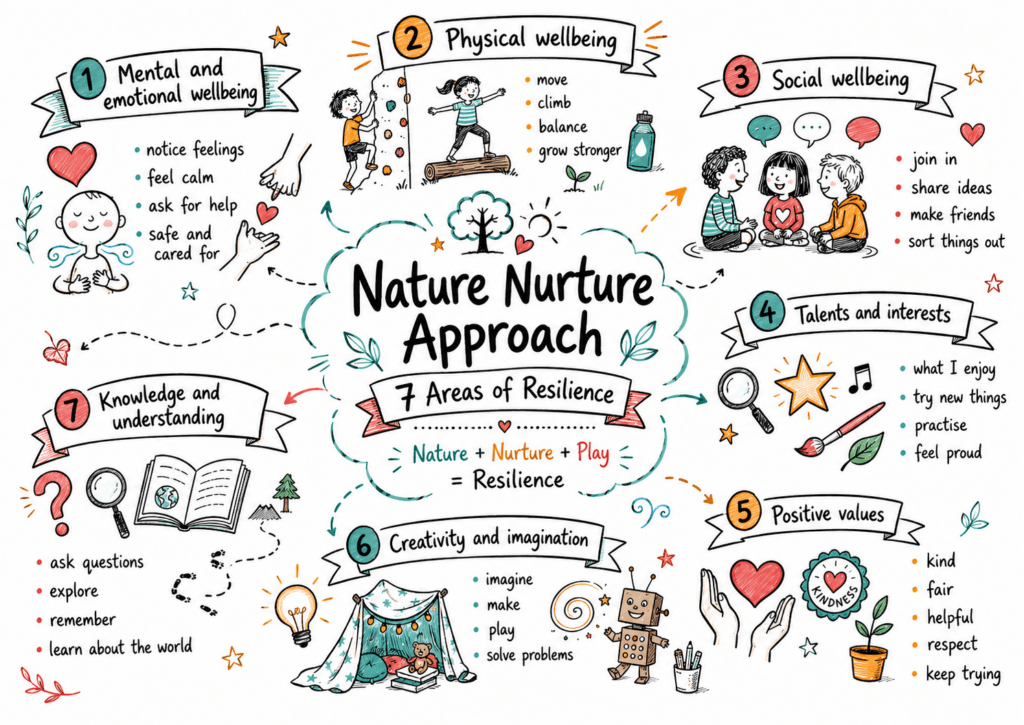
At Nature Nurture, we use seven interconnected areas to help practitioners observe, support and measure children’s developing resilience. These areas were shaped by our experience of outdoor nurture practice, child development, trauma-informed approaches, Waldorf education, Camphill values and resilience-informed frameworks.
Through Nature Nurture we facilitate the development of:
- Mental and emotional wellbeing and development
- Physical wellbeing and development
- Social wellbeing and development
- Talents and interests
- Positive values
- Creativity and imagination
- Knowledge, understanding and cognitive development
These seven areas help us observe the whole child. They help us move beyond a narrow focus on behaviour or attainment and instead ask: what is growing, what is emerging, what is difficult, and what support or experience might help next?
Our profiling tool supports practitioners to record existing strengths, challenges, emerging strengths and next steps across each area. It can be used as a baseline assessment, revisited during a programme, and reviewed again at the end to show change over time. Used alongside child voice, teacher feedback, parent or carer feedback, photographs, notes and learning stories, it creates a fuller picture of impact.
The Nature Nurture Observation of Resilience Tool
Observation is at the heart of understanding children’s development. When observing resilience, it is often best to begin with two or three areas at a time rather than trying to assess everything at once.
Practitioners can gather evidence through:
- brief observation notes
- photographs of play, learning and participation
- children’s comments
- audio or video examples, where appropriate and with consent
- teacher and parent feedback
- reflection notes
- examples of transfer into the classroom, playground or home
The Nature Nurture profile looks at four key aspects in each area:
Existing strengths
What skills, qualities, interests or capacities does the child already have?
Challenges
Where is the child struggling? What causes concern? What may be getting in the way of participation, regulation, learning or connection?
Emerging strengths
What is beginning to appear? What skills are developing but not yet secure?
Next steps
What opportunities and experiences can we facilitate outdoors to support further growth?
The purpose of the tool is not simply to gather data. It is to guide practice. Good observation helps us plan better experiences, notice progress more accurately and communicate children’s strengths and needs more clearly.
- Mental and Emotional Wellbeing and Development
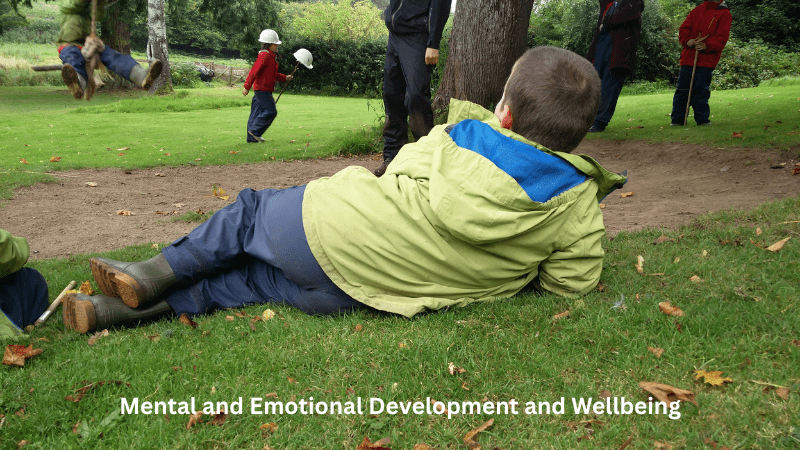
This area focuses on how the child experiences, expresses and manages their inner world.
A child with developing mental and emotional wellbeing may show periods of calm alertness, emotional regulation and a generally positive mood. They may be soothed when upset, feel secure with familiar adults, show confidence in familiar routines, or begin to communicate what they need.
Challenges may include frequent distress, anxiety, low mood, fearfulness, giving up easily, poor self-regulation, frequent fight, flight or freeze responses, difficulty being soothed, limited emotional vocabulary, or poor awareness of their own feelings and the feelings of others.
Emerging strengths might include beginning to trust a key adult, learning to notice body signals, developing feeling words, recognising emotional intensity, identifying triggers, or beginning to use strategies that help them return to calm.
Outdoor nurture can support this area beautifully. Time in nature gives children space to breathe, move, regulate and reconnect. Attuned adults can follow the child’s lead, name emotions gently, offer co-regulation, create calm spaces and model emotional language.
Helpful adult prompts might include:
“I can see your body is telling us this feels tricky.”
“You look proud of yourself.”
“That was frustrating, and you kept going.”
“Would it help to walk together for a minute?”
- Physical Wellbeing and Development
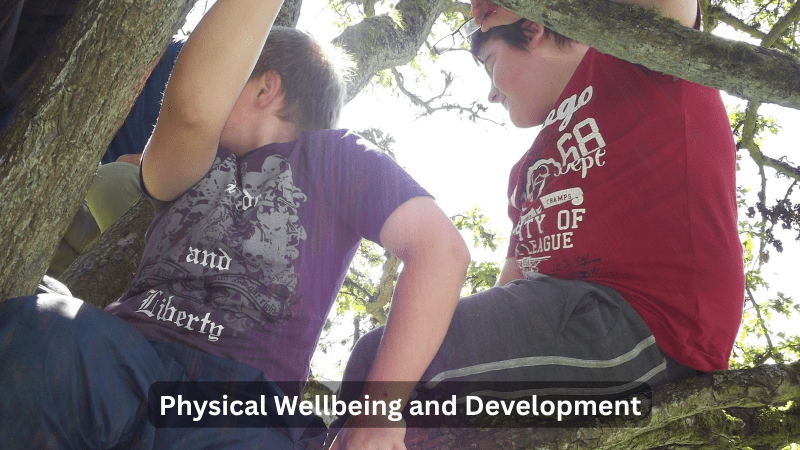
Physical wellbeing is not just about fitness. It includes body confidence, coordination, balance, stamina, sensory awareness, risk awareness and the child’s relationship with movement.
Strengths may include confidence and control in movement, good coordination, balance and stamina, active engagement in physical play, and confidence in managing bodily tasks.
Challenges may include poor balance, low stamina, difficulty with coordination, reluctance to move, poor risk awareness, impulsivity, sensory sensitivities, low physical confidence, or avoidance of activities that feel uncertain or demanding.
Emerging strengths may include growing confidence in gross and fine motor skills, improved strength and stamina, greater awareness of physical limits, safer risk-taking and increased enjoyment of sensory movement experiences.
Outdoor play naturally offers endless opportunities for physical growth. Children can climb, balance, dig, crawl, run, carry, build, swing, roll, jump and explore. Repeated practice matters. A child who crosses a log with support one week may try independently a few weeks later. A child who avoids mud may eventually begin to explore texture with a stick, then a boot, then a hand.
Progress is often gradual, but each step matters.
- Social Wellbeing and Development
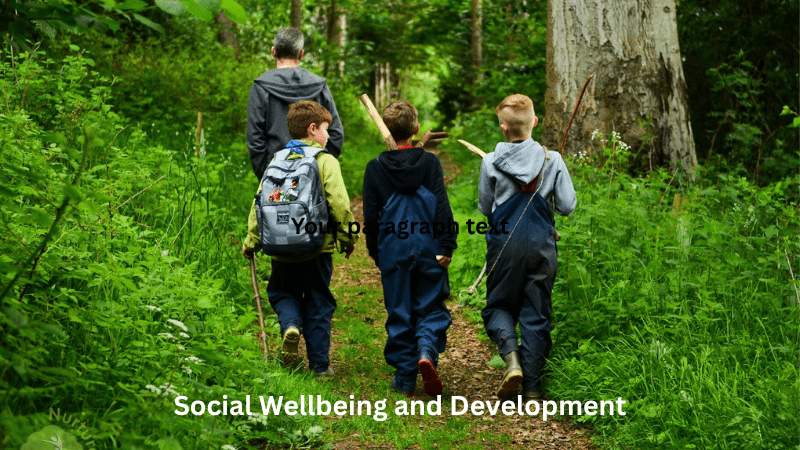
Social wellbeing focuses on how children connect with others, build relationships, participate in groups and manage the inevitable ups and downs of shared play.
Strengths may include joining groups confidently, making friends, building trusting relationships with peers and adults, cooperating, negotiating, sharing ideas and managing social challenges.
Challenges may include social anxiety, withdrawal, difficulty sharing or taking turns, struggling to adapt behaviour in groups, conflict, misunderstanding social cues, or finding it hard to repair relationships when things go wrong.
Emerging strengths may include beginning to trust others, playing near other children, sharing space, taking turns with support, noticing others’ feelings, asking to join in, accepting help, or beginning to resolve conflict with adult support.
Outdoor play provides rich, real social learning. Den building, games, imaginative play, mud kitchens, loose parts and shared adventures all create natural opportunities for children to negotiate roles, solve problems, manage disappointment, listen to others and experience belonging.
We should not avoid all social challenge. Some of the most important learning happens when a group struggles, pauses, repairs and tries again.
- Talents and Interests
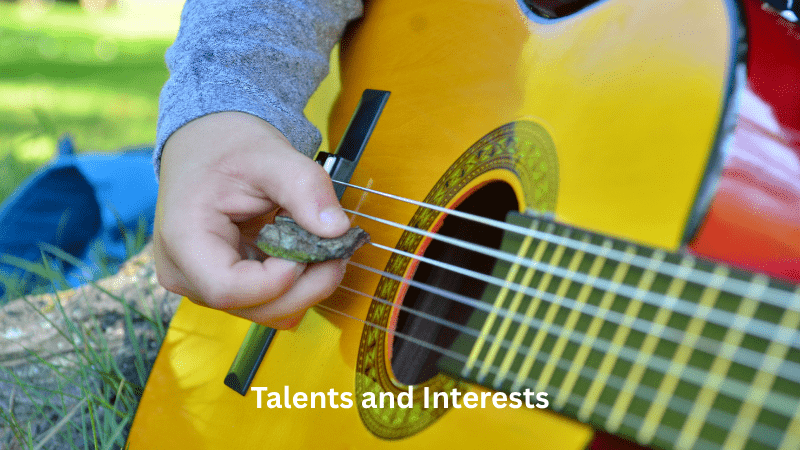
This area helps us notice what lights the child up.
Strengths may include enthusiasm, curiosity, confidence in favourite activities, willingness to learn new skills, pride in achievements, or sharing interests with others.
Challenges may include avoiding new activities, giving up quickly, low confidence, fear of failure, reluctance to share talents, or believing “I’m not good at anything.”
Emerging strengths may include exploring new interests, trying something unfamiliar with encouragement, practising a skill, beginning to recognise progress, or showing pride in effort rather than only outcome.
Talents and interests are powerful because they give children a doorway into confidence. A child who struggles in the classroom may be skilled at finding insects, building dens, remembering bird calls, making stories, spotting tracks, caring for younger children, organising a game, or using tools safely.
When adults notice and name these strengths, children begin to see themselves differently.
“You really understand how to make that structure strong.”
“You noticed something no one else had seen.”
“You kept practising until the knot held.”
These moments can become turning points.
- Positive Values
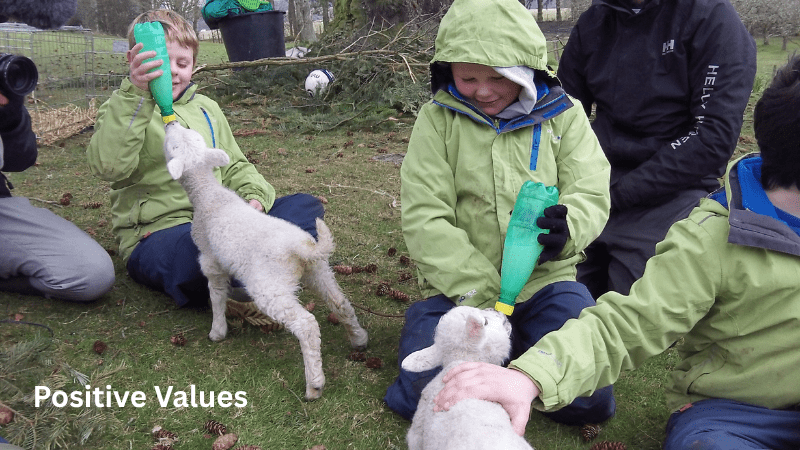
Positive values include kindness, fairness, empathy, responsibility, respect, honesty, patience, perseverance and care for people, animals, plants and places.
Strengths may include showing kindness, helping others, acting fairly, caring for nature, showing respect, persevering and making thoughtful choices.
Challenges may include difficulty sharing, impulsivity, impatience, low empathy, frustration, difficulty following agreed expectations, or not yet understanding the impact of actions on others.
Emerging strengths may include beginning to recognise how actions affect others, learning to wait, showing care for living things, practising honesty, taking responsibility, or trying again after a mistake.
Nature Nurture sessions provide constant opportunities to practise values in meaningful ways. Children can care for the environment, look after tools, help a peer, include someone in play, repair damage, return resources, negotiate rules, or reflect on how their choices affect the group.
Positive values are best taught through lived experience, not lectures. Children learn them by seeing, feeling and practising them.
- Creativity and Imagination
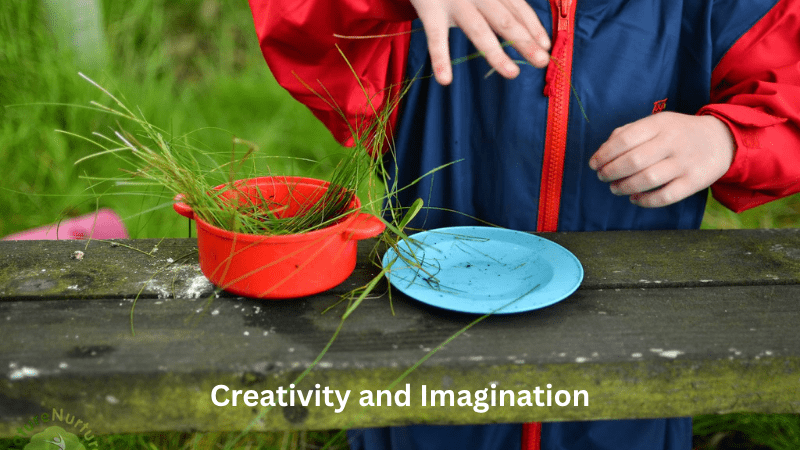
Creativity and imagination are essential parts of resilience. They help children think flexibly, express themselves, invent possibilities and find new ways through problems.
Strengths may include imaginative play, storytelling, role-play, art, music, flexible thinking, creative problem-solving and confidence in expressing ideas.
Challenges may include avoiding creative tasks, limited imaginative play, difficulty with flexible thinking, fear of getting things wrong, or reluctance to express ideas.
Emerging strengths may include beginning to use imagination in play, trying different ways to solve a problem, experimenting with materials, joining a story, making something from loose parts, or taking a creative risk.
Outdoor spaces are full of open-ended possibility. A stick can become a wand, a fishing rod, a flagpole, a bridge, a tool or a boundary marker. A cluster of trees can become a village, a dragon’s cave, a hospital, a hideout or a shop.
When children use imagination outdoors, they are not “just playing”. They are rehearsing flexibility, language, perspective-taking, planning, problem-solving and emotional expression.
- Knowledge, Understanding and Cognitive Development
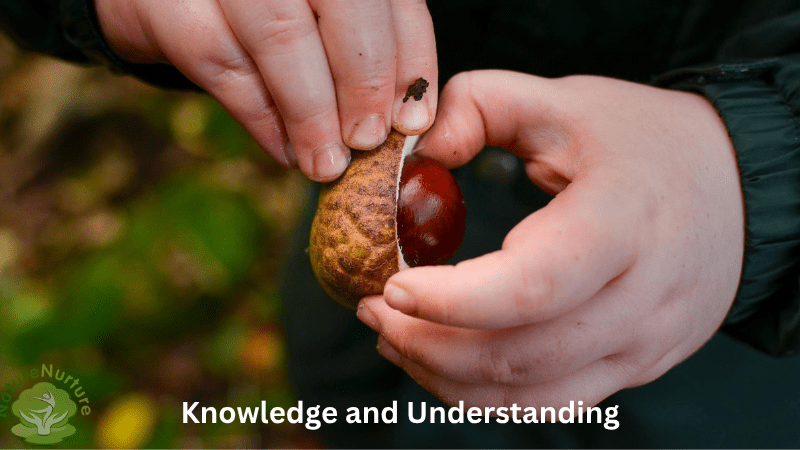
This area focuses on how the child explores, wonders, thinks, communicates and makes sense of the world.
Strengths may include curiosity, focus, problem-solving, asking questions, remembering information, exploring new ideas, communicating thoughts and making connections.
Challenges may include difficulty focusing, low engagement, limited curiosity, avoidance of new learning, difficulty following instructions, limited vocabulary, or finding it hard to express ideas.
Emerging strengths may include asking more questions, exploring independently, building vocabulary through experience, remembering routines, sharing observations, or beginning to explain their thinking.
Outdoor environments support cognitive development because they are alive with real problems and real questions.
Why is this log slippery?
How can we make the den stay up?
Where did the water go?
What happens if we mix mud, leaves and stones?
Which route feels safest?
How do we remember where we left the treasure?
These questions make learning purposeful, embodied and memorable.
Making Growth Visible
The Nature Nurture profiling process can be used at the beginning of a programme, midway through, and at the end. This allows practitioners to notice changes over time and adapt their planning.
However, the profile should not stand alone. A score, checklist or profile can show movement, but it cannot tell the full story.
For this reason, we encourage practitioners to gather a range of evidence, including:
- child voice
- adult observation
- photographs
- short learning stories
- teacher feedback
- parent or carer feedback
- examples of transfer into other settings
- practitioner reflection
A child’s own words are especially powerful. When using a child-friendly reflection tool, such as a Resilience Star, practitioners can record the phrases children use to describe their growth. This keeps the child’s voice at the centre and helps avoid turning resilience into something adults simply measure from the outside.
The aim is not to turn children into data.
The aim is to notice growth, understand need, plan meaningful next steps and celebrate the small signs that show resilience is developing.
From Observation to Next Steps
Once practitioners have identified strengths, challenges and emerging skills, the next step is to plan opportunities for practice.
It is usually best to focus on no more than two or three areas at a time. This keeps planning manageable and makes support more intentional.
For example:
A child who struggles with emotional regulation may need repeated opportunities for co-regulation, calming movement, predictable routines and safe retreat.
A child who struggles socially may need supported small group play, role modelling, shared tasks and gentle help with repair.
A child with low confidence may need opportunities to practise a skill they enjoy, experience success and have their effort noticed.
A child with limited curiosity may need open-ended materials, time to explore and adults who wonder aloud rather than rush to instruct.
This is where Nature Nurture becomes much more than an outdoor activity. It becomes a thoughtful, responsive, relationship-based approach to development.
Why This Matters
When we measure resilience carefully, we become better at seeing children clearly.
We notice the child who is not yet joining in but is staying closer to the group.
The child who is not yet calm but is recovering more quickly.
The child who is not yet confident but is beginning to try.
The child who is not yet able to explain their feelings but is starting to show us what helps.
These are the small signs of deep growth.
Measuring resilience well helps us tell these stories with care, clarity and confidence. It helps practitioners plan. It helps families understand progress. It helps schools and organisations demonstrate impact. Most importantly, it helps children recognise their own growth.
Resilience is not toughness.
It is connection, confidence, agency, emotional safety, curiosity, courage and hope.
And when children experience nature, nurture and play in the presence of adults who believe in them, those qualities can begin to grow.
Taking Your Learning Further
Here are some useful resources for practitioners, educators and organisations who want to explore resilience, outdoor play and holistic wellbeing in more depth.
The Scottish Government’s GIRFEC National Practice Model how the My World Triangle, Resilience Matrix, SHANARRI wellbeing indicators and Curriculum for Excellence contexts support holistic assessment and planning for children and young people.
The Scottish Government’s Out to Play guidance explores the value of outdoor play experiences and recognises the contribution of outdoor play to wellbeing, resilience, physical and mental health, and educational attainment.
The Center on the Developing Child at Harvard University offers a helpful Guide to Resilience explains with accessible explanations of how resilience develops through protective relationships, environments and skill-building.
Harvard’s working paper Supportive Relationships and Active Skill-Building Strengthen the Foundations of Resilience is particularly useful for practitioners who want to understand the science behind resilience and the importance of stable, committed relationships with supportive adults.
Play Scotland’s Outdoor Play and Learning offer a strong Scottish context for understanding why outdoor play matters for children’s health, wellbeing, learning and development.
For more on Nature Nurture, our website explains how the approach promotes resilience and improved wellbeing through carefully attuned nurturing, exciting challenges and nature connection.
You may also enjoy our related Nature Nurture articles:
Why Resilience Matters – Right Now! explores why children need permission to play freely, challenge themselves and have fun outside in natural spaces.
Games and Activities to Promote Social and Emotional Development shares practical ideas for using play and gentle provocations to support connection, emotional expression and social growth.
Pushing the Cart Up the Hill: How Confidence Really Grows reflects on confidence, mistakes, self-talk and how children begin to see themselves as capable.
To explore this work more deeply, the Nature Nurture Approach online course supports educators and practitioners to embed outdoor-based, nurture-informed practice across early years and primary settings. The course follows a cycle of action research: theory, practice, observation, reflection and change.