

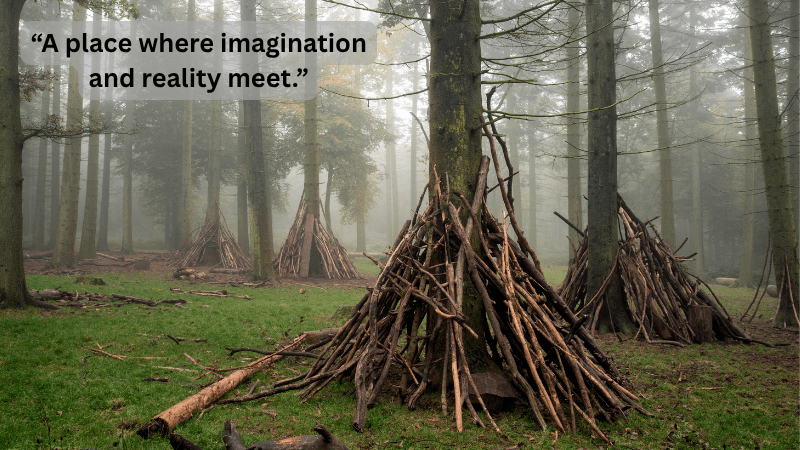
Building Dens: A universal childhood experience
Our fifth cohort of Aberdeenshire Council’s Nature Nurture Practitioners are now well into the final module of the Nature Nurture in Practice training programme. This stage of the journey focuses on the practical application of everything we have explored so far: understanding the principles of the Nature Nurture Approach, recognising the social and emotional needs of the children we support, and responding to the challenges experienced by children with additional support needs.
This is where we begin to see the real impact of professional curiosity, commitment and compassion in action.
This week, our focus is on building dens and shelters. We are exploring not only the practicalities of supporting this kind of play, but also why so many children are instinctively drawn to it, and how it supports resilience, wellbeing and development.
🌱 Think back to your own childhood
Did you build a den, a blanket fort, or find a secret hiding place?
Try to remember what it felt like to be there.
I remember being very small, crawling under low-growing bushes in our garden until I was completely hidden. Lying on my back, I would look up through the branches at fragments of sky. It felt peaceful, contained, and entirely my own. I can still recall the thrill of hearing adults calling for me, staying perfectly still, trying to suppress the giggles as they passed by without noticing.
There is something deeply human in this experience.
🧠 Why are children drawn to building dens?
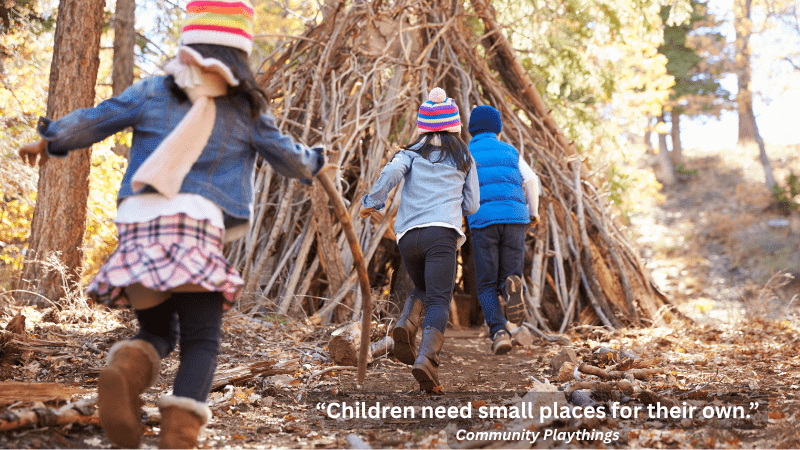
The drive to build shelter is one of the most fundamental human instincts. From an evolutionary perspective, humans have always sought protection, safety and belonging. In children’s play, this instinct reappears in its purest and most creative form – building dens.
But den building is far more than a survival echo. It is rich, purposeful play.
Research into children’s play highlights the importance of enclosed, self-created spaces. As Community Playthings note:
“Children need small places for their own… places where they can experience a sense of control and privacy.”
Similarly, Helen Tovey reminds us:
“Children are strongly drawn to creating their own spaces, places that are set apart from the wider environment.”
These “spaces within spaces” offer something profoundly important. They provide children with a sense of agency, ownership and emotional safety.
Dens can be:
- A social hub within a game
- A quiet retreat
- A place to belong
- A place to be alone
- A world shaped by imagination
As Peter Gray argues in his work on play:
“In play, children learn to make their own decisions, solve their own problems, and regulate their own emotions.”
Building dens embodies all of this.
🌿Supporting children’s needs through den building
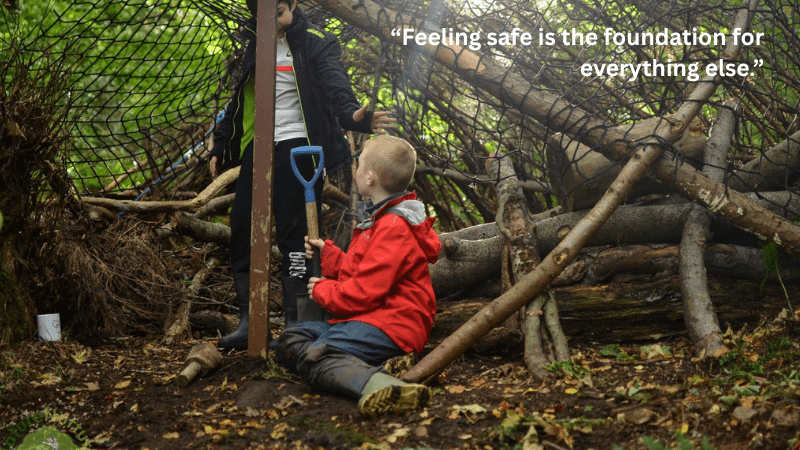
When we look through a Nature Nurture lens, the power of den building becomes even clearer.
For a child who feels anxious, unsafe or overwhelmed, a den can become a self-created safe space.
For a child with sensory needs, it can offer control over light, sound and proximity.
For a child who struggles socially, it provides a manageable, shared project with clear purpose.
For a child who finds classroom learning challenging, it offers success through creativity, problem-solving and collaboration.
In this one activity, we see opportunities across all areas of resilience: emotional, social, physical, cognitive and creative.
🔧 Creating the conditions for building dens
So what do we need to provide?
The answer always begins with the children in front of us.
Some may be drawn to more complex, Forest School-style structures using branches, ropes and tarps. Others may need a more sensory, flexible approach using fabrics of different textures, weights and levels of transparency.
Possible resources might include:
- Branches, sticks and natural materials
- Tarps, fabrics and ground sheets
- Rope, paracord, string or jute
- Pegs, clips and fasteners
- Simple tools such as secateurs or loppers (with appropriate support)
But the most important resource is the adult.
Children need an adult who:
- Is attuned to their ideas and emotions
- Facilitates rather than directs
- Models possibilities when needed
- Supports safe risk-taking
- Allows space for trial, error and creativity
This is not about teaching children how to build a “perfect” den.
It is about enabling them to explore, create and learn through the process.
🌳The importance of time and reflection
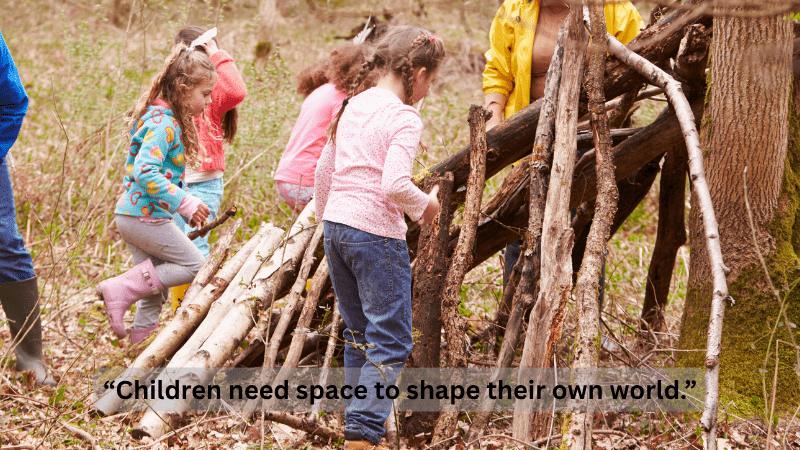
After all the busyness of creating, children need time.
Time to be in the space they have made.
Time to enjoy it.
Time to share it or to sit quietly within it.
Dens are rarely permanent. The need to dismantle them at the end of a session can feel genuinely painful for children.
We can support this by:
- Preparing children in advance
- Taking photographs of their creations
- Encouraging them to talk about and share their process
- Creating displays or records of their work
- Reassuring them that they can build again, and build differently next time
And we must also take time ourselves to reflect:
- What needs were met through this activity?
- What did we observe about the child’s resilience?
- What might be the next step?
- What resources or support could extend this learning?
🌿Further Reading and Research
If you would like to explore this area further, the following accessible resources offer valuable insights:
More About Nature Nurture…
Our professional development pathways — Nature Nurture Approach and Nature Nurture in Practice — support practitioners to bring these principles into everyday practice with confidence and clarity. The Nature Nurture Approach focuses on creating inclusive, play-rich environments for groups of children, while Nature Nurture in Practice offers more targeted support for small groups of children with additional support needs. Together, they guide professionals through the theory, reflection and practical application of nurturing resilience through nature, nurture and play. This learning is further supported through our weekly Substack, Nature Nurture and Additional Support Needs, offering ongoing insight, ideas and encouragement for those working with children.