

In the Nature Nurture Approach, our primary aim is to facilitate play that is freely chosen, child-initiated and led by children’s imagination and curiosity. This is where we see the deepest engagement, creativity and emotional expression.
However, there are times when a well-timed game, resource or activity can act as a gentle provocation, a spark that sets play and connection in motion.
In this week of the Nature Nurture in Action course with Aberdeenshire Council practitioners, we are exploring these playful “trigger points”: how and when to use them, and, just as importantly, how to let them go.
🌱 The Adult Role: “On Tap, Not On Top”
The adult role in play is subtle but powerful.
At times, we might model, suggest or introduce, but always with the intention of stepping back. Being “on tap, not on top” means we are available, responsive and attuned, without taking control.
Sometimes all it takes is a simple, thoughtful provocation. A basket of materials. A new idea. A story starter.
And sometimes, what children need most, especially older children, is permission to play again. One of my favourite examples of this is when we used an old wicker picnic hamper filled with hats and lengths of fabric as provocations for a group of 8 – 11-year-olds. These resources became cloaks, saris, veils, costumes and characters. The response was immediate and joyful. Many of these children hadn’t been “allowed” to play dressing up for years. Their play exploded into dramatic storytelling, shared narratives and collaborative imagination.
🌿What About Games and Activities?
Unlike open-ended resources, games often come with rules, structure and adult-led instruction. As adults, we can be quite attached to the “right” way to play. But what happens when we loosen that grip?
When children begin to organise and adapt games themselves, they are learning to:
- negotiate and compromise
- manage frustration
- take turns and share attention
- cope with winning and losing
- think flexibly and respond to others
And perhaps most importantly, they begin to negotiate, adapt and co-create shared experiences.
Of course, this process is rarely smooth. The “that’s not fair” moments, the disagreements about rules, the frustration the competitive aspects of organised play may cause conflict. These are not problems to eliminate.
This uncomfortable part of organised games is the part where children establish an excellent grounding in social communication, empathy and inclusion. It’s also where children start to conflict resolution, understand compassionate collaboration, teamwork and social justice. So, lean into that discomfort and don’t step in too quickly, facilitated problem solving rather than ‘sort out’ the issues that arise.
🌼Play vs. Organised Games and Activities: Finding the Balance
Play builds autonomy, creativity and intrinsic motivation.
Organised games, when used thoughtfully, can scaffold key social skills such as turn-taking, cooperation and emotional regulation.
And when children take ownership of games themselves, those benefits deepen even further.
The key is not whether games are used, but how and why.
🌳Games and Activities to Support Social and Emotional Development
🤝Trust – Activities that build trust help children feel safe, connected and part of a group. These experiences invite children to rely on one another and reflect on what it means to be trustworthy.
Blindfold Leading
Children work in pairs, with one guiding the other (who is blindfolded or has eyes closed) along a simple outdoor route. The focus is on clear communication, care and responsibility. Afterwards, reflecting on how it felt helps deepen understanding of trust and empathy.
Transporting the Injured
In small groups, one child takes the role of someone who cannot walk, while others work together to carry or support them safely across a short distance. This encourages teamwork, problem solving and a strong sense of responsibility for others.
🤝 Games and Activities to Support Co-operation and Collaboration
These activities strengthen communication, shared problem solving and collective creativity.
Balancing Line Challenge (Log or Rope)
Children stand together on a log or rope laid on the ground and are challenged to change positions without stepping off. This requires communication, patience and physical awareness, as well as supporting one another to succeed.
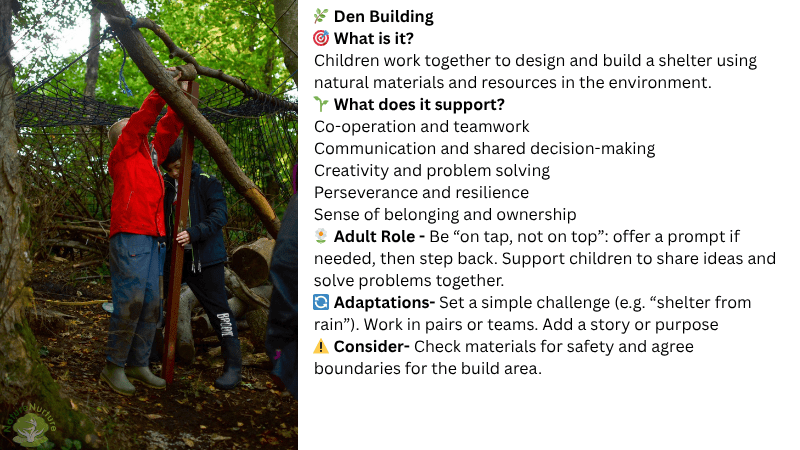
Den or Shelter Building
Given a shared challenge such as “it’s about to rain, how can we build a shelter?”, children collaborate to design and construct something together. This promotes creativity, shared decision-making and cooperative problem solving.
🌿 Games and Activities to Support Self-Regulation
These games offer rich opportunities to practise impulse control, awareness and emotional regulation, especially when children co-create the rules and risk assess together.
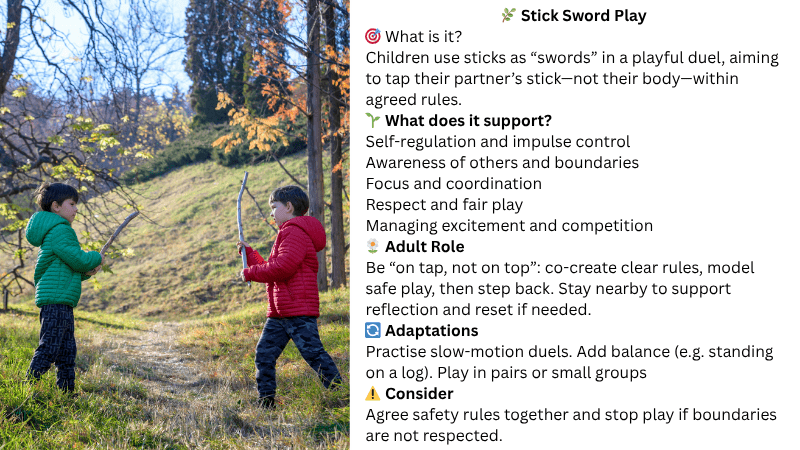
Stick Sword Play
Using agreed boundaries (only striking sticks, not bodies), children engage in playful sparring. This requires control, focus and awareness of others. Adding elements like balancing on a log increases the challenge and deepens regulation skills.
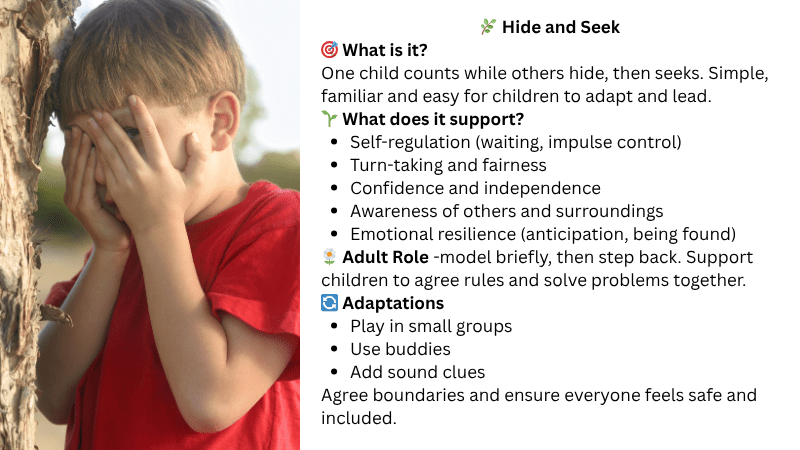
Hide and Seek (and Variations)
A familiar and adaptable game that supports impulse control, patience and anticipation. Inviting children to invent new versions adds creativity and ownership.
🌱 Games and Activities to Support Awareness of Boundaries
Boundaries are not just about keeping everyone safe, they can also help children to feel secure, emotionally contained and help groups develop shared responsibility.
Creating a Play Boundary Together
Children walk the around the perimeter of their play space, identify play opportunities, risks and decide where boundaries should be placed. Marking them together builds ownership, understanding and a sense of shared responsibility.
Capture the Flag
A team game involving strategy, movement and cooperation within defined boundaries. It encourages awareness of space, teamwork and rule-following, while still allowing flexibility and adaptation.
🌼Games and Activities for a Single Child
For practitioners working one-to-one with a child, social and emotional development can still be richly nurtured through playful, relational experiences.
In these moments, the adult becomes the play partner, modelling turn-taking, shared attention and emotional language in a natural and responsive way. It is important not to interrupt a child who is deeply engaged in solitary play unless invited. However, when connection is welcomed, simple shared experiences can be powerful, such as building a rope swing or hammock together, creating imaginative worlds with natural loose parts, or engaging in gentle chase or hide-and-seek games.
These interactions help children practise reading cues, managing small frustrations and experiencing the rhythm of connection within a safe, attuned relationship. Over time, this builds confidence, trust and emotional security, forming a strong foundation for future social engagement.
We always aim for one-to-one sessions to be time-limited. Children need regular opportunities to be alongside and with other children in order to develop and extend their social and emotional skills. Nature Nurture works best in small groups, even when being together feels challenging. In fact, it is often within these moments of difficulty, negotiating, repairing and reconnecting, that the most meaningful and lasting learning takes place.
🌿Conclusion
In Nature Nurture, we don’t replace play with organised games and activities, we protect play and use games thoughtfully as a relational tool. We offer ideas, then step back.
Because the real power of any game lies not in the rules, but in the relationship holding it.
📚 Further Reading
For those interested in exploring social and emotional development through play, there is a strong and growing body of research that reinforces the value of both child-led play and thoughtfully facilitated experiences.
The American Academy of Pediatrics – The Power of Play highlights how play supports children’s emotional regulation, resilience and secure relationships, showing that both free play and guided play have an important role in healthy development.
Similarly, the Harvard Center on the Developing Child offers clear, accessible research on how playful, responsive interactions — often described as “serve and return” — build strong neural connections and underpin children’s emotional wellbeing.
In a UK context, Play England – The Importance of Play provides a strong evidence-informed overview of why freely chosen, child-led play is essential for children’s social competence, creativity and sense of belonging.
Alongside this, Education Scotland – Realising the Ambition offers valuable guidance on the role of the adult in play, particularly the importance of being responsive, attuned and enabling rather than directive—an approach that closely aligns with the Nature Nurture principle of being “on tap, not on top.”
Several key texts offer deeper insight into how play, games and activities and outdoor learning support children’s development. In Free to Learn, Peter Gray presents compelling evidence that self-directed, child-led play is fundamental to developing independence, creativity and social skills, while also recognising the benefits of shared play experiences such as games. In Play: How It Shapes the Brain, Stuart Brown explores the neuroscience of play, showing how structured and unstructured play both contribute to emotional regulation and social bonding.
From an outdoor learning perspective, Balanced and Barefoot by Angela Hanscom highlights how movement, risk and unstructured outdoor experiences support sensory integration and emotional wellbeing, offering important insight into when adult involvement can enhance rather than interrupt play. Similarly, Playing and Learning Outdoors provides a thoughtful exploration of how adults can create rich outdoor environments that support social and emotional development through play, while knowing when to step back and allow children’s ideas to take the lead.
Together, these sources reinforce a key message at the heart of the Nature Nurture Approach: that children’s social and emotional development is best supported through play that is meaningful, relational and child-led, with adults providing the conditions, presence and gentle guidance that allow that play to flourish.
More About Nature Nurture ….
Our professional development pathways — Nature Nurture Approach and Nature Nurture in Practice — support practitioners to bring these principles into everyday practice with confidence and clarity. The Nature Nurture Approach focuses on creating inclusive, play-rich environments for groups of children, while Nature Nurture in Practice offers more targeted support for small groups of children with additional support needs. Together, they guide professionals through the theory, reflection and practical application of nurturing resilience through nature, nurture and play. This learning is further supported through our weekly Substack, Nature Nurture and Additional Support Needs, offering ongoing insight, ideas and encouragement for those working with children.