

Play and Learning
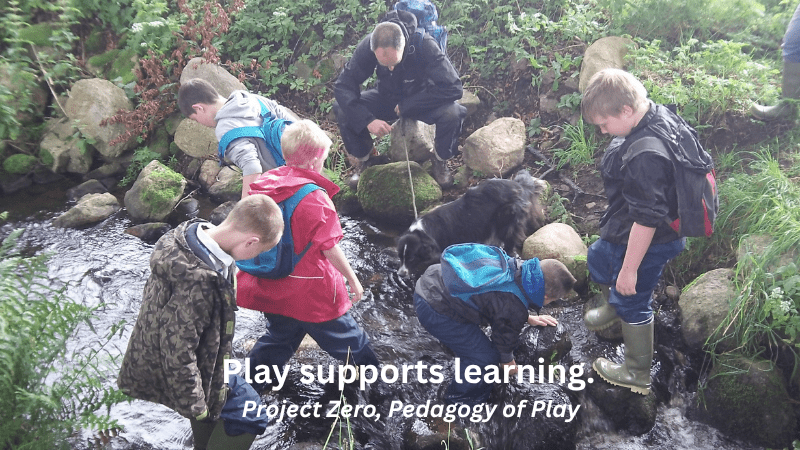
This week I had the pleasure of facilitating conversations about outdoor pedagogy that is inclusive, enabling, curiosity-led and playful. I was working with a group of dedicated and skilled teachers from a school in Aberdeenshire, as part of a professional learning programme that will span two terms. The programme includes collegiate sessions, both face to face and online, practical workshops and group coaching. Together, we are building confidence, understanding and inspiration around outdoor learning, while keeping children’s wellbeing, engagement and inclusion at the centre. In our latest session, we considered play in its many forms and reflected on how playful learning, when led by children’s curiosity, can become a powerful route into deep and lasting learning. The group shared some wonderful examples from recent practice, but we also noticed something important. Most of the examples came from the lower school, particularly the early and first level stages. This opened up a rich professional conversation. How do we ensure that playful, enquiry-based outdoor learning does not disappear as children move through primary school? How do we make space for curiosity, movement, exploration and imagination for older children too? And how do we hold onto the value of play as a serious and inclusive pedagogy, rather than something children are expected to grow out of?
What Is Outdoor Pedagogy?
Outdoor pedagogy is the art and practice of teaching with the outdoor environment, rather than simply teaching in it. In the Nature Nurture Approach, outdoor pedagogy means creating the conditions where children can learn through play, movement, curiosity, sensory experience, relationship, appropriate risk, reflection and connection with the natural world. The adult role is intentional but responsive. We observe closely. We offer nurture. We extend enquiry. We support social development. We notice what children are communicating through their play, movement and choices. We allow children’s own interests to shape meaningful learning, while still holding our professional understanding of the curriculum, child development and wellbeing. Reggio Emilia practice is often associated with the idea that the aim of teaching is not simply to produce learning, but to produce the conditions for learning. This invites us to think differently about our role as educators. Rather than seeing teaching as something we deliver to children, we can understand it as the careful creation of environments, relationships and experiences that make learning possible. In outdoor learning, this means asking a deeper question. Are we simply planning activities for children to complete, or are we creating the right conditions for children to explore, wonder, move, collaborate, take appropriate risks, solve problems and make meaning for themselves? The conditions for learning might include an environment rich in possibility, open-ended resources, time for deep engagement, responsive adults, emotional safety, opportunities for choice, and a culture where children’s ideas are noticed, valued and extended. This does not mean the adult has no role. In fact, it requires skilled and thoughtful adult practice. The adult observes closely, listens carefully, notices what children are drawn to, introduces language, offers gentle challenge, supports regulation and relationships, and knows when to step in and when to step back. The adult also helps children make their learning visible. This might be through photos, floor books, learning walls, children’s words, shared reflection or documentation that helps children recognise what they have discovered, practised, changed or understood.
Outdoor Activities and Outdoor Pedagogy Are Not the Same Thing
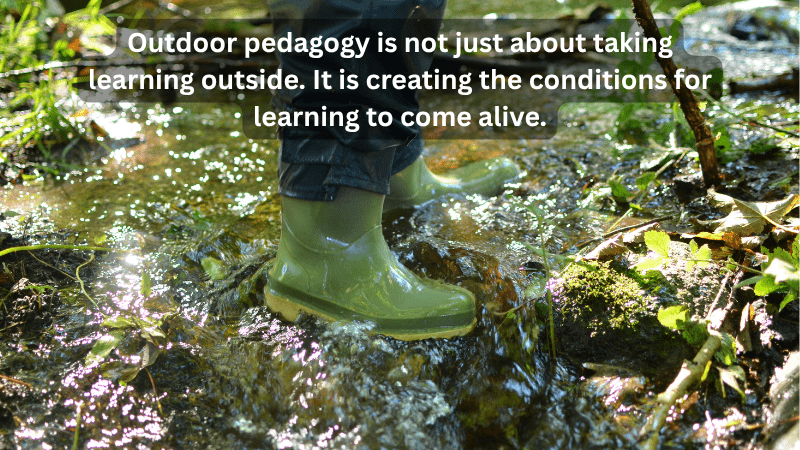
Outdoor activities are what children do outside. Outdoor pedagogy is why and how we use the outdoors to support learning, development and wellbeing. Outdoor activities might include den building, scavenger hunts, planting seeds, making mud faces, reading under a tree, or doing maths with sticks and stones. These activities can be enjoyable and valuable, but on their own they are simply tasks or experiences. Outdoor pedagogy is the professional thinking behind those experiences. It is about how the adult uses the outdoor environment intentionally to support children’s learning, emotional regulation, relationships, confidence, curiosity, communication, problem-solving, physical development and wellbeing. For example, children might collect leaves and sort them by colour, shape or size. As an outdoor activity, this is a simple sorting task. As outdoor pedagogy, the adult recognises that the outdoor space offers real objects, movement, sensory experience, choice and conversation. They might use the experience to support observation, descriptive language, classification, mathematical thinking, turn-taking and connection with nature. They might adapt the invitation for children who need movement, quiet space, social support, sensory regulation or additional challenge. Outdoor activities ask, “What are we going to do outside?” Outdoor pedagogy asks, “What learning, development or wellbeing need are we supporting, and why is the outdoor environment the right place to support it?” This distinction matters. Outdoor learning is not simply taking indoor tasks outside. It is not about having a list of nice activities to fill time. Outdoor pedagogy means understanding how the outdoor environment changes the learning experience. It gives children space to move, regulate, explore, take appropriate risks, use their senses, collaborate, solve problems and connect learning to real-life experiences. Activities are the vehicle. Pedagogy is the driving. Activities are what we offer. Pedagogy is how we make them meaningful..
Why Playful Outdoor Learning Matters
At first glance, play might seem separate from academic achievement. However, a growing body of writing and research helps us understand that creativity, playful exploration and child-led enquiry are not distractions from learning. They are central to deeper learning. Peter Gray’s work highlights the importance of child-directed play in developing problem-solving, critical thinking, self-regulation and social skills. Through play, children practise negotiation, empathy, conflict resolution, flexible thinking and perseverance. These are not soft extras. They are foundational skills for learning, relationships and participation in the classroom. Sir Ken Robinson argued powerfully that schools should nurture creativity rather than suppress imagination and curiosity. From this perspective, playful learning supports divergent thinking, adaptability, innovation and engagement. Children are more likely to remember, apply and extend learning when it has been meaningful, active and connected to their own questions. Project Zero’s Pedagogy of Play work at Harvard also treats play as a serious pedagogy. It explores how playful learning can make children’s thinking visible, strengthen reasoning and help teachers observe, assess and extend learning in responsive ways. In playful contexts, adults can often see children’s understanding more clearly than they might through written outcomes alone. Sue Palmer’s writing on childhood, development and real-world learning also reinforces the importance of play as a foundation for healthy development. Playful learning gives children opportunities to make sense of the world through direct experience. It can bring literacy, numeracy, social understanding and emotional development into meaningful, practical contexts. Play Scotland and Play England have both advocated for the importance of play across childhood, not only in the earliest years. Their work reminds us that play supports wellbeing, resilience, physical health, social development and motivation. These are all essential foundations for successful learning. In the Nature Nurture Approach, play is not seen as a reward after work. Play is one of the core ways children learn, communicate, regulate and connect. This is true for young children, but it remains true as children grow older. Older children may not need the same play opportunities as younger children, but they still need curiosity, choice, movement, creativity, agency and meaningful challenge
Enquiry-Based Learning Outdoors
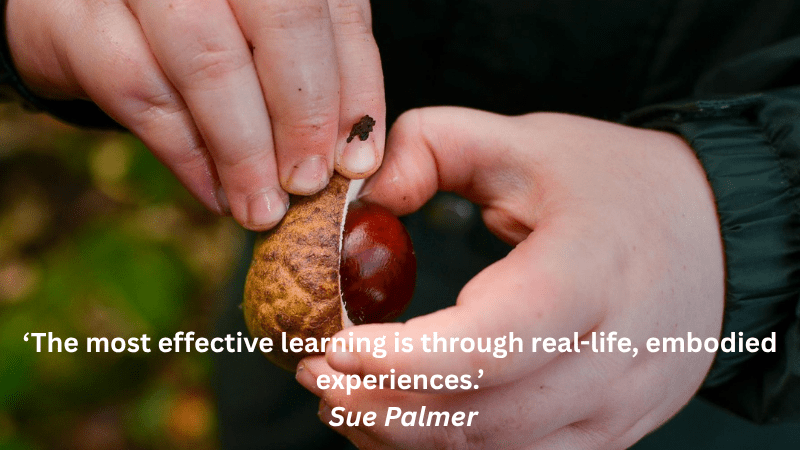
Enquiry-based learning is about helping children investigate, ask questions and construct understanding through experience. It is not about the adult giving all the information first and then asking children to remember it. Instead, the adult creates the conditions for children to notice something, become curious, test ideas, talk with others and make connections. This links closely to play because play is already full of enquiry. When children build, dig, mix, climb, role play, collect, sort, hide, negotiate or imagine, they are asking questions through action. What happens if I put this here? How can I make this balance? Why is this patch muddy? How can we make our den bigger? What will happen if we add water? Teaching through provocation means offering something that invites thinking without over-directing it. A provocation might be an interesting object, a question, a natural material, a problem, a story starter, a tool, a change in the environment, or a challenge linked to something the children have already shown interest in. A tray of mixed natural materials might invite the question, “What could these become?” A puddle, some guttering and containers might invite children to explore how water travels. Sticks, fabric, washing line and pegs might become an invitation to design a shelter. A collection of leaves, seeds and cones with magnifiers might encourage children to notice, compare and wonder. A story character placed outdoors might open up questions about habitat, need, danger, comfort, shelter and belonging. The adult role is to observe, listen, extend language, offer gentle challenge, support collaboration and help children reflect on what they are discovering. The skill lies in supporting children’s thinking without taking it over. A useful reflective question for practitioners is: what is the difference between giving children an activity and offering a provocation? An activity often has a planned outcome. A provocation opens a door.
Play-Based Learning as an Inclusive Pedagogy
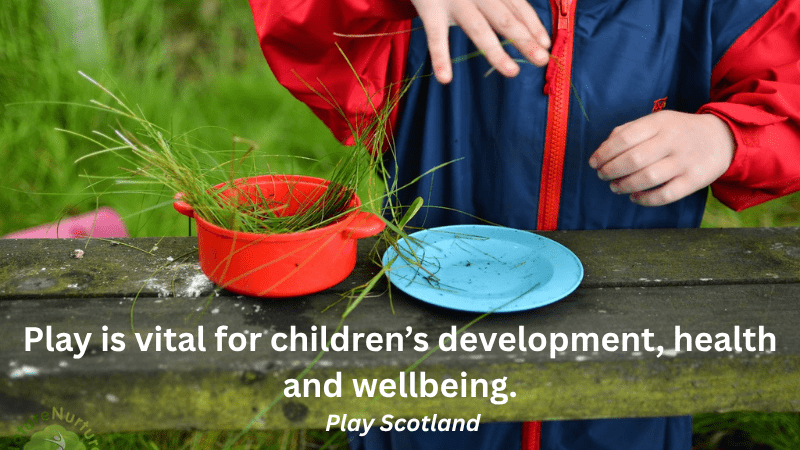
Playful outdoor pedagogy can be particularly powerful for children who find classroom-based learning difficult. Some children struggle with sitting still, processing verbal instructions, managing social expectations, sustaining attention, regulating emotions, or showing what they know through writing. The outdoor environment can reduce some of these barriers. It offers movement, space, sensory regulation, real materials, flexible grouping, practical problem-solving and multiple ways to participate. A child who struggles to explain an idea on paper may show sophisticated thinking while building a shelter, changing a water channel, negotiating rules for a game, mapping a route, sorting natural materials or leading a group investigation. This is why outdoor pedagogy sits so naturally alongside inclusive practice. It gives children more than one way to engage, more than one way to communicate, and more than one way to show their learning. However, inclusion does not happen automatically just because children are outside. The adult still needs to plan carefully and responsively. Some children may need clear boundaries, predictable routines, visual support, co-regulation, sensory consideration, adult proximity or carefully scaffolded social opportunities. Others may need more challenge, more independence, or more room to lead. Inclusive outdoor pedagogy asks us to notice who is participating, who is on the edge, who is leading, who is overwhelmed, who is hiding their uncertainty, and who may need a different doorway into the learning.
Making It Manageable
One of the common questions teachers ask is, “How do you plan for child-led, open-ended learning?” At first, planning and free play can seem as though they do not belong together. But in Nature Nurture, we are not planning every action the children will take. We are planning the opportunity. We begin with children’s needs, wishes, questions and curiosities, and we match these with our knowledge of the curriculum, learning progressions, relationships and wellbeing. We provide tools and materials that enable exploration without restricting children to one fixed pathway. We think carefully about our language, our open-ended questions, our invitations and the minimum scaffolding needed to keep everyone safe and able to cooperate. We also need to plan for our own role. How will we support children’s thinking without hijacking it? How will we hold back when we see a problem, so children have the chance to test, adapt and discover for themselves? How will we help children make their learning visible during and after the experience? A simple five-part Nature Nurture outdoor planning frame can help. First, begin with need. What do these children need just now? Do they need regulation, connection, movement, curiosity, confidence, social practice, language development or challenge? Second, consider space. Where outside would best support this? It might be a quiet corner, a playground, a group of trees, a grassy area, a wall, a loose parts area, a boundary walk or a familiar gathering place. Third, shape the invitation. What simple provocation, question, object, material or task will invite engagement without closing the learning down too quickly? Fourth, clarify the adult role. Do you need to model, observe, co-regulate, scaffold, step back, narrate, wonder aloud, introduce vocabulary, support collaboration or help children make links to curriculum concepts? Finally, plan for reflection. How will you notice impact? In every outdoor enquiry, aim to capture at least one comment, photo, child quote, staff observation, behaviour change or engagement signal. Then consider how you will document this in a way that helps children revisit and recognise their own learning.
Making Learning Visible
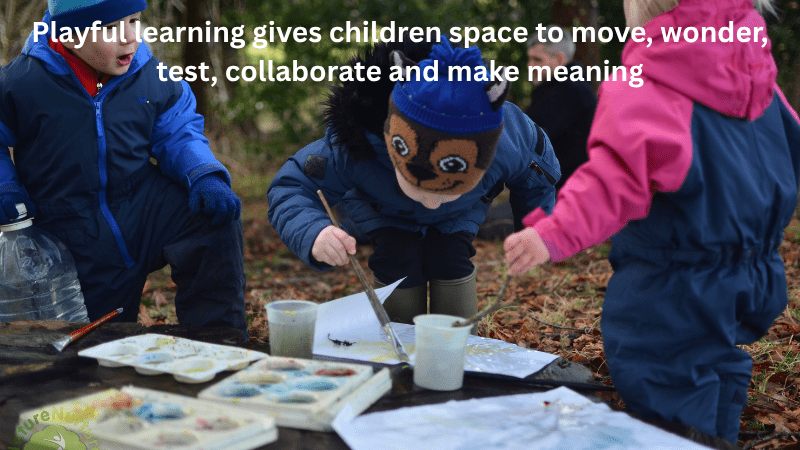
Outdoor and playful learning can sometimes be difficult to capture through traditional written outcomes. Some of the richest learning happens through movement, talk, collaboration, problem-solving, experimentation and emotional growth. This is where floor books, learning walls and documentation can be so valuable. A floor book or visible learning wall documents learning as it unfolds, rather than only displaying finished work. It helps make children’s thinking, questions, decisions, mistakes, adaptations and discoveries visible to the children themselves, to adults, and to families or visitors. In an enquiry-based outdoor learning context, documentation can show the whole learning journey. It can capture what sparked children’s curiosity, what they wondered, what they tried, what changed, and what they understood by the end. A floor book might include children’s questions, photos of the process, children’s words and explanations, adult observations, drawings, maps, plans, vocabulary, evidence of change over time, and new questions for future enquiry. A visible learning wall works in a similar way but is displayed in the classroom, corridor or shared space. It might include the starting question or provocation, photos from outdoor learning, children’s wonderings, emerging vocabulary, diagrams, examples of children’s talk, adult prompts, curriculum links and reflections such as, “We used to think… now we think…” The important thing is that this is not just a display of neat outcomes. It should show the thinking behind the learning: the attempts, adaptations, choices and discoveries. Documentation helps children revisit and remember their learning. It shows them that their ideas matter. It builds language for explaining learning and helps children see how their thinking has changed. It also enables teachers to assess learning more holistically, especially in contexts where children may show their understanding more clearly through action, talk and collaboration than through written work.
•••
Further Reading and Resources
If you would like to explore outdoor pedagogy, playful learning and enquiry-based practice more deeply, the following texts and resources are helpful starting points.
Juliet Robertson’s Dirty Teaching: A Beginner’s Guide to Learning Outdoors is one of the most accessible texts for practitioners. It is practical, school-facing and grounded in the idea that outdoor learning can be woven into ordinary teaching, rather than treated as an occasional event. Juliet Robertson’s work continues to offer profound support for teachers and practitioners who want to build confidence in taking learning outside.
Helen Tovey’s Playing Outdoors: Spaces and Places, Risk and Challenge is valuable for understanding the depth of children’s outdoor play. Tovey explores children’s use of space, imagination, risk, challenge and the adult role in supporting and extending free play. It is particularly helpful for thinking about outdoor play as meaningful learning, rather than a break from learning.
Sue Waite’s edited book Children Learning Outside the Classroom: From Birth to Eleven offers a strong overview for early years and primary settings. It explores theory, curriculum links, practice across different contexts and ways of evaluating outdoor learning. It is useful for practitioners who want to understand outdoor learning as part of whole-school practice.
Project Zero’s Pedagogy of Play resources from Harvard Graduate School of Education are helpful because they treat play as a serious pedagogy. They explore how playful learning can shape teaching, learning, assessment, environment and school culture.
The UNICEF and LEGO Foundation report Learning through Play: Strengthening Learning through Play in Early Childhood Education Programmes is a useful international resource. It frames learning through play as central to holistic development, not only as preparation for academic learning.
Exploring the Pedagogy of Learning and Playing Outdoors, edited by Mehmet Mart, Georgia Gessiou and Jane Waters-Davies, focuses directly on the professional decisions adults make when children are playing and learning outside. It explores adult intention, purpose, inclusion, the continuum from free play to structured activity, and the values that shape outdoor practice.
Education Scotland’s outdoor learning resources are helpful for schools in all regions and countries, particularly their framing of outdoor learning as engaging hearts, heads and hands. This sits well alongside the Nature Nurture Approach because it recognises learning as emotional, cognitive, physical and relational.
Learning through Landscapes is also a useful UK-based source for schools. Their resources help make outdoor learning feel achievable, practical and connected to curriculum, wellbeing, nature connection and school improvement.
For practitioners interested in inclusion, the literature on Universal Design for Learning and outdoor learning is particularly relevant. It helps us think about how outdoor environments can reduce barriers to participation when planned thoughtfully, while reminding us that inclusion requires intentional adult practice.
Outdoor pedagogy is not simply the relocation of classroom tasks into a greener space. At its best, it is a relational, responsive and inclusive way of teaching, where children learn through movement, curiosity, sensory experience, social negotiation, meaningful risk, enquiry and play.
Take Your Learning Further
For practitioners and schools who would like to take this learning further through a nurturing, inclusive and resilience-focused lens, Nature Nurture offers a range of professional learning pathways. Our Nature Nurture Approach course supports educators and practitioners to embed outdoor play, learning and nurture into everyday practice with groups of children. Nature Nurture in Practice provides a deeper targeted pathway for practitioners supporting children with additional support needs, trauma, anxiety, social and emotional challenges, or barriers to participation.
We also offer consultancy, coaching and practical training for schools and settings who want to build staff confidence, develop a shared outdoor learning culture and make small, sustainable changes that have a meaningful impact for children. You can explore our full range of courses, resources and professional development options through the Nature Nurture website and online shop.