

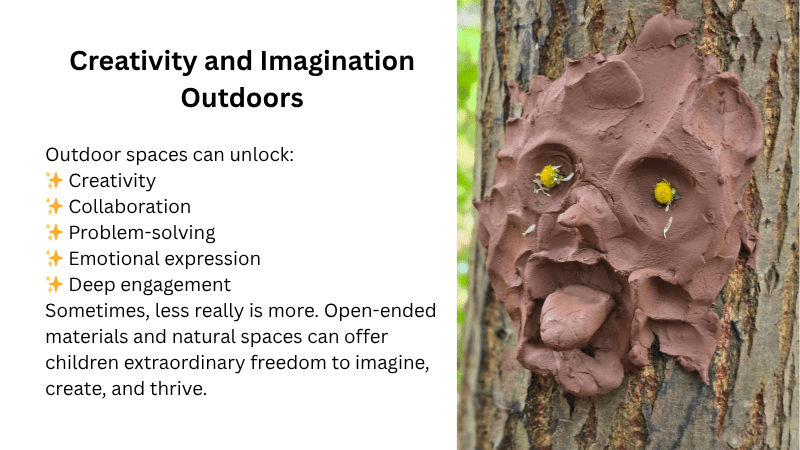
This week I’m pausing my reflections on the Nature Nurture in Action course and turning my attention to another exciting piece of work currently taking shape.
This week I’ll be joining my colleague Dawn Ewan of Dawn Ewan Consultancy to deliver an in-service day for Aberdeen City early years practitioners. While this training sits within our Outdoors Thinking work, the theme of outdoor imaginative and creative play feels deeply connected to Nature Nurture too, and relevant to anyone working with children of any age.
I absolutely love Outdoors Thinking approaches and feel incredibly proud to be an affiliate trainer. The wisdom of Jan White, creator of the Outdoors Thinking approach, alongside the insight and dedication of Menna Godfrey, has profoundly shaped my own practice. Their work has helped countless practitioners recognise the immense value of outdoor play in children’s development and wellbeing, and that influence continues to inspire and strengthen my own work through Nature Nurture.
Our day is centred around the theme:
Imaginative and Creative Play Outside
At its heart is the simple but powerful question, ‘What difference does it make when play happens outdoors?’
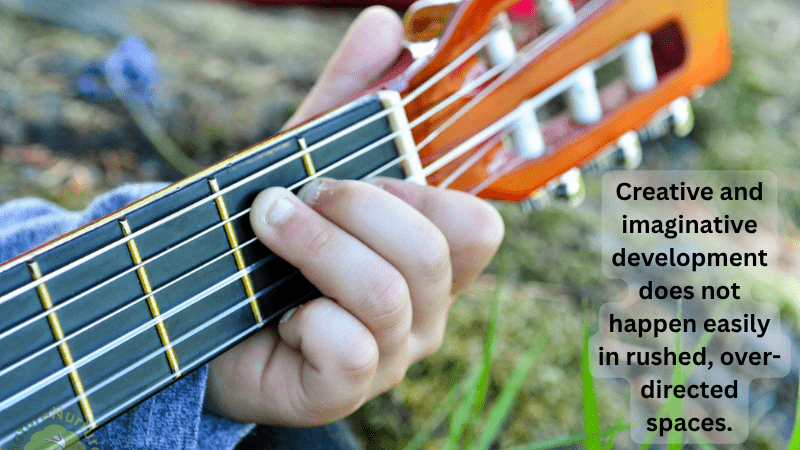
During the day, I’ll be guiding practitioners through outdoor small world play, while Dawn will lead creative exploration using chalks and fabrics outdoors. Participants will have dedicated time to immerse themselves in each experience, working in small groups, before coming together to reflect on what unfolded.
We’ll be encouraging them to notice:
- How outdoor spaces stimulate imaginative thinking
- How natural environments shape creative choices
- How freedom, scale, texture, and unpredictability influence play
- Why taking expressive arts outdoors matters so deeply
What excites me most is that this day is not about delivering fixed answers. It is about creating the conditions for adults to rediscover something vital through direct experience.
Imagination and Creativity: What’s the Difference?
Preparing for this training has prompted me to think more deeply about imagination and creativity.
They are deeply connected, but they are not quite the same.
Imagination is our inner world. It is the ability to picture what is not currently there. It allows children to invent stories, explore possibilities, wonder “what if?”, and mentally transform one thing into another.
Imagination is thinking beyond reality.
Creativity is imagination expressed. It is the doing, the making, the problem-solving, the storytelling, the movement, the transforming of thought into action.
For example:
A stick may become a sword, a magic wand, or a brave adventurer through imagination.
Creativity is what happens when that imagined possibility is acted upon. The stick gains a character, a story, a role, perhaps even googly eyes and a twine scarf.
Yet in truth, the process is rarely linear.
Sometimes imagination sparks creativity. Sometimes creative engagement with materials sparks imagination.
Children move fluidly between the two.
This is why open-ended play resources matter so much.
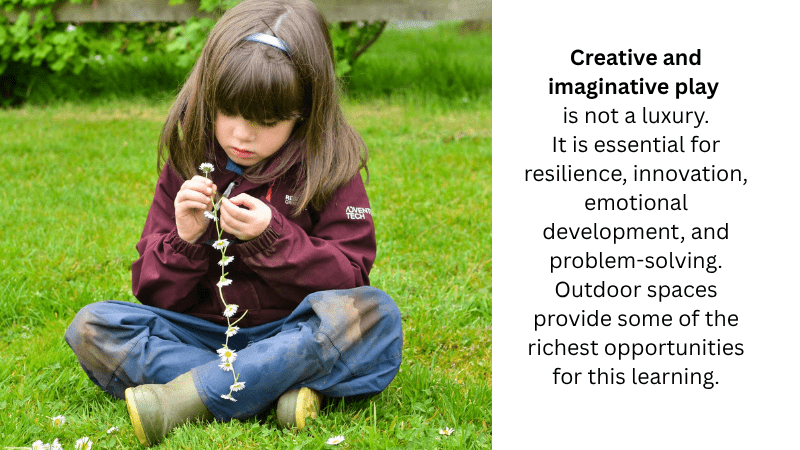
Why Open-Ended Materials Matter
Drawing on my background in Waldorf-inspired approaches, I remain a strong advocate for natural materials, simple toys, and resources that leave space for children’s own ideas.
For this training, I’ve gathered a wide range of play materials, including:
- Faceless wooden figures
- Wooden figures with detailed features
- Fully formed plastic characters
- Natural loose parts
- Waldorf-style dolls
- Conventional plastic dolls
Practitioners will have time to explore how these different resources shape play experiences.
Which toys invite deeper projection, storytelling, and possibility? Which toys inhibit imaginative opportunity through over-definition? Which resources offer genuine freedom?
My hope is that participants come to feel, rather than simply discuss, an important truth:
Less is often more.
The more open-ended the resource, the greater its potential to support imagination, creativity, collaboration, and deep play.
And when those materials are taken outdoors, into rich micro-landscapes filled with sticks, stones, mud, textures, weather, and natural unpredictability, the possibilities expand even further.
The Environment Matters
Creative and imaginative development does not happen in rushed, over-directed spaces.
For both children and adults, these experiences require:
- Time
- Freedom
- Flexibility
- Open-ended materials
- Responsive adults
- Rich sensory environments
To enter true flow states, uninterrupted time is essential.
Outdoor environments offer children something many indoor spaces cannot: freedom from unnecessary boundaries.
Their imagination becomes, in many ways, “free range.”
This is why the role of the adult is so important.
Too often, adults unintentionally dominate children’s play through over-direction, predetermined outcomes, or by imposing their own creative ideas.
Instead, our role should be to remain:
On tap, not on top.
To facilitate rather than control. To observe rather than dominate. To support rather than restrict.
Why This Matters So Much
Creative minds are resilient minds.
Children who are given time, freedom, and opportunity to exercise their imaginative and creative capacities become:
- Better problem solvers
- More adaptable thinkers
- More emotionally expressive
- More collaborative
- More innovative
These capacities are not simply “nice extras.”
They are foundational to lifelong wellbeing, learning, and resilience.
In a world that can often feel increasingly pressured, restrictive, and outcome-driven, protecting children’s right to imaginative and creative play outdoors feels more important than ever.
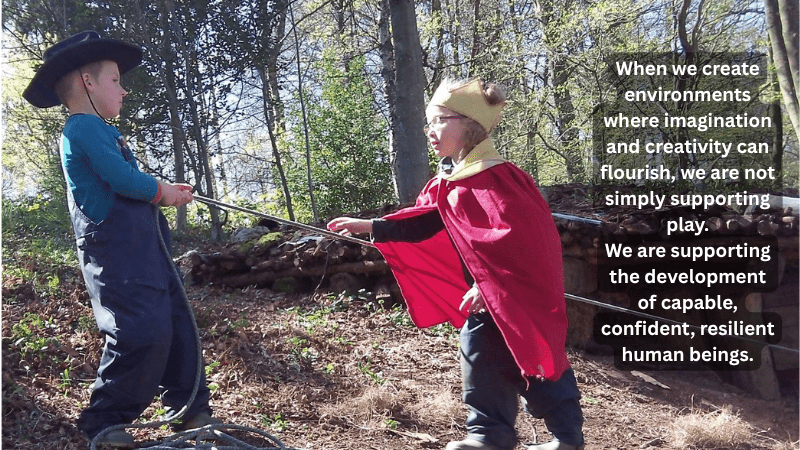
When we create environments where imagination and creativity can flourish, we are not simply supporting play.
We are supporting the development of capable, confident, resilient human beings.
And that matters enormously.
Further Reading and Helpful Resources
For those wishing to explore these ideas further, here are some valuable organisations and approaches that continue to shape best practice in outdoor play, creativity, and child-centred learning:
Outdoors Thinking – Jan White’s pioneering work on outdoor environments for young children
Dawn Ewan Consultancy – Outdoor learning, creativity, and early years professional development
Reggio Emilia Approach – Child-led, creative, inquiry-based education
Waldorf Education / Steiner Approach – Imagination, creativity, and holistic child development
Loose Parts Play – Inspiration around open-ended materials and creative exploration
More About Nature Nurture…
Our professional development pathways — Nature Nurture Approach and Nature Nurture in Practice — support practitioners to bring these principles into everyday practice with confidence and clarity. The Nature Nurture Approach focuses on creating inclusive, play-rich environments for groups of children, while Nature Nurture in Practice offers more targeted support for small groups of children with additional support needs. Together, they guide professionals through the theory, reflection and practical application of nurturing resilience through nature, nurture and play. This learning is further supported through our weekly Substack, Nature Nurture and Additional Support Needs, offering ongoing insight, ideas and encouragement for those working with children.