

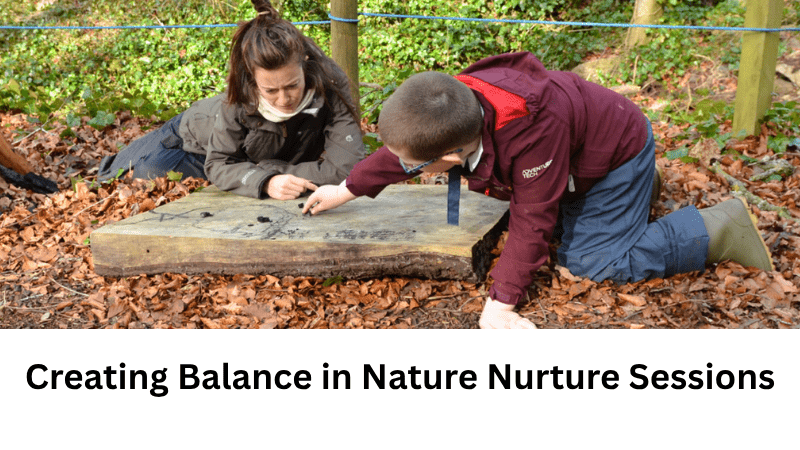
Creating Balance in Nature Nurture Sessions is one of the most important skills practitioners develop as they become more confident in outdoor, nurture-based practice. A well-planned session is a little like a nourishing meal. We need to think carefully about the ingredients available to us, the needs of the children in front of us, and how to create an experience that feeds the body, mind and emotions.
The word balance is crucial. No two Nature Nurture sessions will look the same because every group has its own rhythm, energy and needs. One group may arrive full of movement, noise and excitement. Another may arrive hesitant, anxious or unsure. Some children may need to run, climb, pull, carry and move before they can settle. Others may need time to feel safe, connected and gently welcomed into the space.
Creating Balance in Nature Nurture Sessions is not about filling time with activities. It is about being responsive, noticing the group carefully and making thoughtful choices. Do they need up-regulating or down-regulating? Do they need more freedom or more structure? Do they need to come together as a group, or do they need space to explore alone or alongside others?
When this balance works well, the group begins to feel like a living, breathing organism. There is movement and rest, talking and listening, child-led play and adult-guided activity, individual discovery and shared belonging. This is where outdoor learning becomes more than a session plan. It becomes a nurturing, relational experience.
Creating Balance in Nature Nurture Sessions through rhythm and routine
Children often feel safer when they know what to expect. This does not mean every session should be rigid or overly planned, but it does mean that predictable rhythms can help children settle into the experience.
Simple rituals and routines can support transitions beautifully. You might begin by greeting a particular tree, gathering in a familiar circle space, walking the boundary together, or opening a basket of resources that signals the start of the session. These small, repeated moments give children a sense of security. They say, “We know this place. We know what happens here. We belong.”
Circle games can also help bring the group together. A short game such as 1, 2, 3, Look! can create connection, shared laughter and a sense of arrival. For some groups, this may be enough. For others, the group may need something more active before they are ready to listen or collaborate.
Provocations are another powerful way to begin. A basket, bag or treasure chest of resources can inspire curiosity and imaginative play. This might include ropes, pulleys, magnifying glasses, bug boxes, natural materials, dressing-up hats, maps, tools, identification charts or story prompts. The key is to allow children time to discover the materials and make meaning from them. The adult is nearby, attentive and available, but not taking over.
Boundaries also form part of the nurturing rhythm of a session. These can be revisited playfully by planting flags, hanging bunting, walking the edge of the space or agreeing a clear signal for returning. Some groups may also respond well to a “reverse boundary”, where children can go as far as they wish as long as they can still see the adult and return quickly when called. As always, this depends on the children, the site, the level of trust and the risk assessment in place.
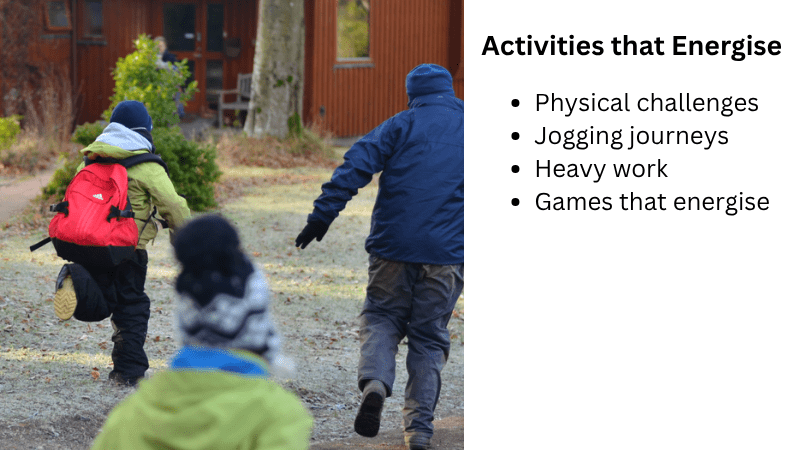
Activities that energise the group
There are times when a group feels flat, tired or disconnected. At other times, children may need to move strongly before they can settle into focused play or reflection. Physical movement outdoors can support mood, motivation and readiness for learning. The NHS highlights that physical activity can support children’s health and should include both aerobic activity and activities that strengthen muscles and bones. The Royal College of Psychiatrists also notes that exercise releases endorphins and positively affects dopamine and serotonin, which are linked with mood and anxiety.
In Nature Nurture sessions, energising activities might include:
Physical challenges: Create a nature gym, obstacle course or woodland workout. Invite children to design challenges for each other, such as balancing along logs, jumping between markers, crawling under branches or moving like different animals.
Jogging journeys: Go for a gentle jog together to a familiar landmark. This can be especially helpful when children arrive full of energy and need a clear, shared movement task.
Heavy work: Lifting, carrying, pulling and pushing can be regulating for many children. Carrying backpacks, transporting water, dragging a log with a rope, digging in an agreed digging area, or helping move resources can all provide meaningful physical input.
Games that energise: Running, chasing, racing and team games can help children reconnect with their bodies, each other and the outdoor space.
The important point is to use energising activities intentionally. The aim is not to wind children up and leave them there. The aim is to help them move through energy into a more regulated, ready state.
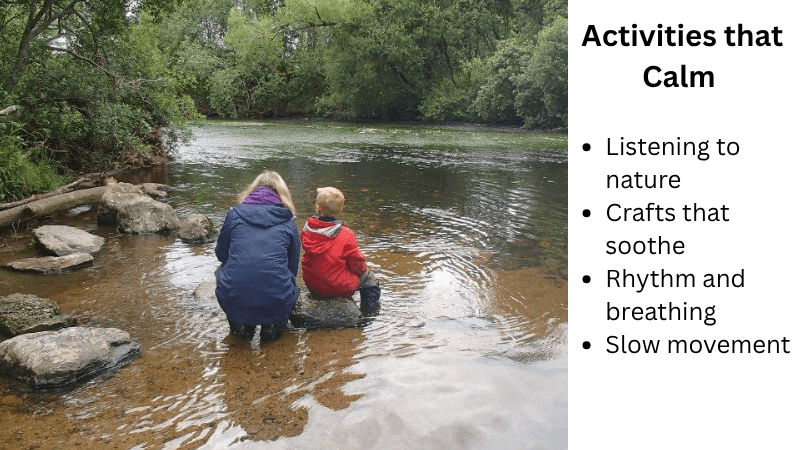
Activities that calm and soothe
Creating Balance in Nature Nurture Sessions also means knowing when to slow things down. If the group becomes overwhelmed, overstimulated or dysregulated, calming activities can help children return to a more settled state.
Sensory activities can be very supportive, but they need to be planned with care. Practitioners should consider children’s sensory preferences and sensitivities. What soothes one child may overstimulate another. For some children, lying on a blanket and watching clouds move through the trees may be deeply calming. For others, gentle swinging, tactile play, quiet singing or listening to natural sounds may help.
Calming activities might include:
Listening to nature: Lie on a tarp or blanket and listen carefully. Children can close their eyes and lift one finger for each sound they hear.
Crafts that soothe: Repetitive, rhythmic crafts such as Nordic braiding, weaving, natural cordage, felting, clay modelling, macramé, dream catchers or wind chimes can help children settle into a calm pattern of movement.
Rhythm and breathing: Gentle songs, lullabies, slow clapping rhythms, working songs or soft drumming can support co-regulation. Simple breathing games, such as pretending to blow out candles on each finger, can help children engage without feeling self-conscious.
Slow movement: Invite children to move like an owl flying silently through the trees, a fox stalking through long grass, or a wildcat creeping through woodland. Moving slowly and quietly can change the atmosphere of a group very quickly.
Learning through Landscapes describes the calming effect of connecting with nature, including how time in green spaces can support stress reduction and mood. Play Scotland also highlights the value of outdoor play for children’s health, wellbeing, concentration and development.
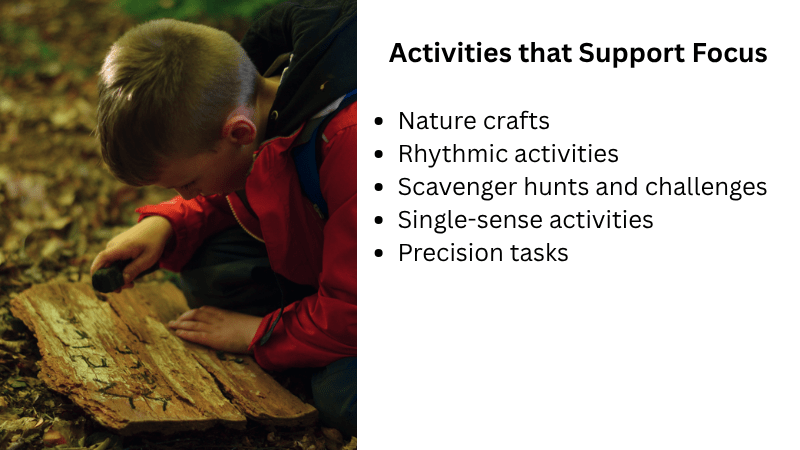
Activities that support focus and flow
Focus is not the same as stillness. Many children concentrate best when their hands are busy, their senses are engaged, and the task has meaning. Outdoor environments offer rich opportunities for children to enter a state of flow, where they become deeply absorbed in what they are doing.
Activities that support focus might include:
Nature crafts: Elder beads, natural mobiles, weaving, dream catchers or clay work.
Rhythmic activities: Nordic slinging braids, clapping games, action songs or repeated movement patterns.
Scavenger hunts and challenges: Searching for colours, textures, shapes, natural objects or signs of wildlife.
Single-sense activities: Listening for a particular bird call, looking for one shade of green, finding smooth or rough textures, or noticing different scents in the woodland.
Precision tasks: Whittling, tying knots, making cordage or carefully drawing what can be seen nearby.
These activities can be especially helpful for children who find classroom-based concentration difficult. The outdoor space provides movement, sensory input and purpose. Focus is practised in short, meaningful bursts rather than demanded as a fixed behaviour.
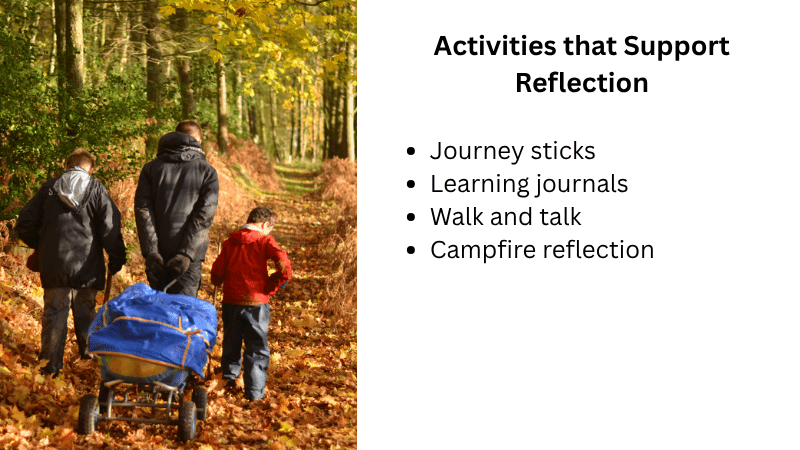
Activities that support reflection
Reflection is one of the great gifts of Nature Nurture practice. When children are supported to notice what they have experienced, what they have learned, and how they have changed, they begin to develop self-awareness and confidence.
It is often helpful to begin with positive reflection. What went well? What did I enjoy? What did I notice? What helped me? What did someone else do well? These questions help children experience reflection as something supportive rather than critical.
Reflection tools might include:
Journey sticks: Children collect small natural objects along the way and tie them to a stick in order. The stick becomes a visual story of the session or programme and can be used to help children remember and share their experiences.
Learning journals: These can include children’s words, drawings, photographs, maps, adult observations and comments. For children who find writing difficult, an audio journal or video diary may be more accessible.
Walk and talk: Some children reflect more easily while moving side by side rather than sitting face to face. A quiet walk can open up thoughtful conversation.
Campfire reflection: Gathering around a fire, where appropriate and safely managed, can create a cosy and memorable space for stories, gratitude and shared reflection.
Emotion supports: Tools such as Emotion Works or other emotional literacy frameworks can help children name feelings, notice changes and understand themselves more clearly.
Reflection does not need to be long or complicated. It simply needs to be regular, relational and meaningful.
Ending Nature Nurture sessions well
Endings matter. For some children, transitions are hard, and finishing something enjoyable can be one of the most difficult parts of the session. Creating Balance in Nature Nurture Sessions means giving enough time for a gentle conclusion.
A rushed ending can leave children unsettled. A thoughtful ending can help them gather up the experience and carry something positive away.
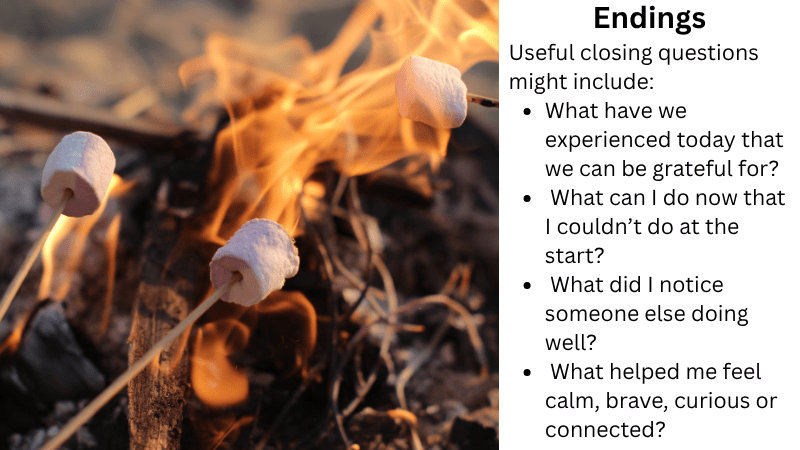
Useful closing questions might include:
What have we experienced today that we can be grateful for? What can I do now that I couldn’t do at the start? What did I notice someone else doing well? What helped me feel calm, brave, curious or connected? How might I use this skill again?
Where possible, finish in a circle to strengthen the feeling of belonging before the group disperses. Make space to resolve any conflict or upset, and help every child leave with something positive, however small. This might be a skill they practised, a kind moment they noticed, a natural object they found, or a memory they want to keep.
Some groups benefit from moving indoors for a snack after the outdoor session. This can soften the transition and help children return to the next part of the day with a little more ease.
A final thought: balance is responsive, not perfect
Creating Balance in Nature Nurture Sessions is not about planning the perfect sequence of activities. It is about becoming more observant, responsive and attuned. It asks us to notice the children, the weather, the group energy, the emotional climate and the possibilities of the place.
Some days the group will need more movement. Some days they will need more quiet-time. Some days the most important learning will happen in a conflict, a repair, a moment of courage, a shared laugh, or a child lying still under the trees and noticing the sky.
Take Your Learning Further
This content has grown from the Nature Nurture in Practice course. For practitioners who want to deepen their targeted outdoor support for children with additional support needs, trauma experiences, social and emotional challenges, or regulation needs, Nature Nurture in Practice offers a more specialist pathway. Our broader Nature Nurture Approach course supports educators, early years practitioners and group leaders to build regular outdoor learning, nurture and play into everyday practice. Together, these professional pathways help practitioners use nature, nurture and play to support children’s resilience, wellbeing and holistic development.
Further reading and resources can be found at:
Education Scotland: Outdoor learning and Curriculum for Excellence
Play Scotland: The Power of Play
Scottish Government: Out to Play practical guidance
Learning through Landscapes: Outdoor learning and wellbeing
NHS: Physical activity guidelines for children and young people