
This week I have been reading Dan Heath’s book Upstream, and it has made me think deeply about the crisis in support for children with additional support needs (ASN or SEND if you are in England).
Every day there are news articles, reports and social media posts filled with the anguish of parents, carers and professionals trying to get it right for every child. In my experience of schools, there are not uncaring adults standing by. There are armies of exhausted professionals and families doing their best to respond to growing levels of: behaviour that challenges, disengagement, school refusal, anxiety and despair in children.
The problem is not usually ill intention. The problem is that so much of our effort is focused on rescuing children once they are already struggling downstream, rather than asking what is happening upstream that is causing so many of them to fall into difficulty in the first place.
Dan Heath offers a striking metaphor. Two adults are standing in a river, desperately pulling children out of a raging torrent. They save one child, then another, then another, but more children keep coming. One of the adults walks away, to the horror of the other. He has not deserted the cause. He is going upstream to stop children falling into the water in the first place.
That image feels painfully familiar in education.
We cannot stop rescuing children downstream. We will always need people there. But if we become more aware of what is happening upstream, and if we work collaboratively to change the conditions that are sweeping children into distress, we may be able to reduce some of the panic, overwhelm and suffering that meet them further down the river.
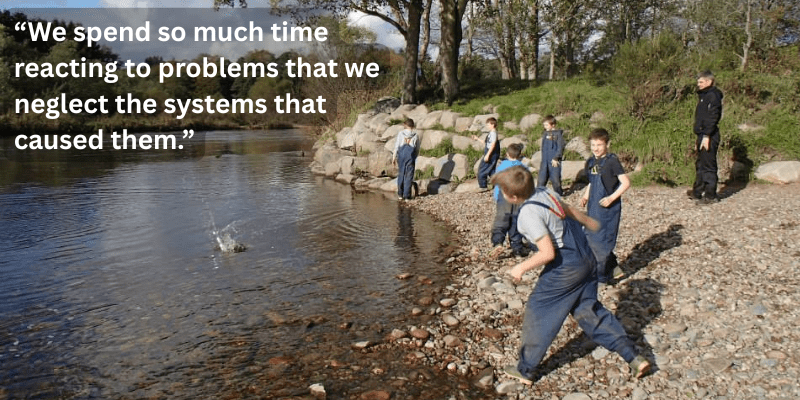
As Heath writes, “We spend so much time reacting to problems that we neglect the systems that caused them.”
What do we Mean by Downstream in ASN?
Downstream responses can initially feel positive because they create the impression of action. A child is distressed and an adult steps in. A child is dysregulated and a plan is put in place. A child is disrupting learning and a consequence follows. Something has happened, and that can feel reassuring in the moment.
There can even be a kind of adrenaline in it. We are rescuing. We are responding. We are doing something.
But after a while, when you need to keep jumping into the torrent, and when the same children keep coming back in crisis, the limits of downstream work become painfully clear. You begin to realise that you are repeatedly responding to the effects of a problem rather than changing the conditions that created it.
Sometimes our downstream reactions are genuinely intended to help. At other times, they are more about stopping behaviour that adults find difficult, disruptive or threatening. These responses can become punitive. They can restrict, remove or exclude. They can talk about consequence and ‘learning lessons’ without meeting the need that sits underneath the behaviour.
Take Callum. He has ADHD and is struggling in class, especially during maths and literacy, where children are expected to sit quietly and focus on independent work for up to thirty minutes.Callum fidgets. He seeks stimulation. He tries to get the child next to him to play a game on the desk. His teacher notices the chatter and the lack of concentration; gives him a stern telling off and separates him from his friend. Callum reacts angrily and swears. Senior Management are called. He is taken to the office and kept in for part of his break.
The disruption has stopped for now, but Callum’s needs have not been met. Nothing has changed about the demands of the classroom, the lack of movement, the limited sensory support, or the mismatch between the environment and his nervous system. The likelihood is that the same scene will play out again.
Then there is Sam. Since the pandemic, she has repeatedly refused to come to school. Staff have tried to support her mum to set firmer boundaries. They have experimented with part time timetables and incentives. They have offered alternative activities if she manages to come in. Yet none of this has made a lasting difference to the intense anxiety she feels each morning. Eventually the school makes a referral to CAMHS.
That may sound like an upstream response, but at that point Sam is already deep in the downstream rapids. If she had been noticed at the earliest signs of distress, if belonging, gentle reintroduction, relational support and emotional safety had been prioritised from the start, then perhaps the trajectory would have been different. Too often meaningful help arrives only once crisis has fully taken hold.
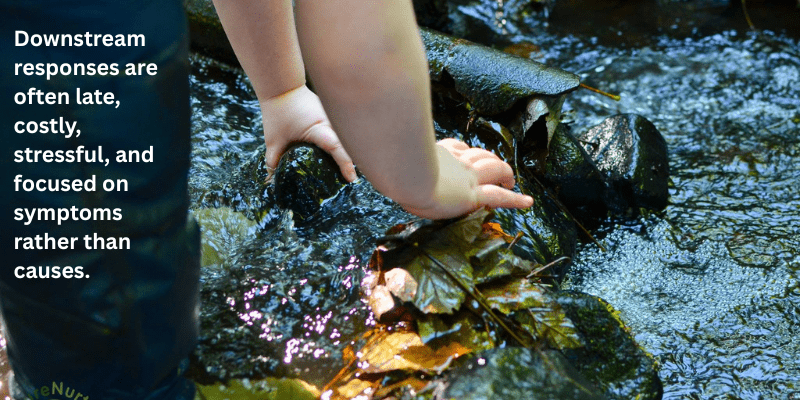
This is why downstream responses are so often late, expensive, stressful for everyone, and focused more on symptoms than on causes.
The Human Case for Upstream Thinking in ASN
The human cost of late intervention is profound.
Many children internalise the repeated failure of adults to understand or respond to their needs early enough. They begin to believe that they are the problem. They carry shame, confusion and a growing sense of disconnection. Children who live under sustained stress may begin to dissociate, shut down, disengage or swing into chronic states of fight, flight or freeze. Their distress becomes visible through behaviour, but by then the behaviour is often what adults are reacting to rather than the deeper pain and unmet need beneath it.
Bruce Perry’s work helps us understand why this matters so much. The more stressed the child, the more the brain shifts into survival mode. A child whose nervous system is primed for danger is not readily available for learning, reflection, impulse control or healthy social connection.
Research and practice both tell us the same thing. Chronic stress affects the very areas of development that children most need to thrive. Emotional regulation, memory, attention and executive function all suffer when a child is living in a state of ongoing overwhelm.
Belonging matters here too. A strong sense of belonging at school is closely linked to children’s wellbeing. When children feel seen, known and safe, they are more able to regulate, engage and learn. When they feel misunderstood, judged or repeatedly corrected, the opposite often happens. Their relationship with school becomes associated with failure, threat or humiliation.
This is why upstream approaches matter so much. They do not just reduce incidents. They change children’s lived experience.
The Moral Case for Upstream Thinking in ASN
There is also a moral question at the heart of this.
Why do we so often wait for children to fail before we act?
Why do some children need to become distressed enough, disruptive enough, absent enough or unwell enough before the system recognises that something is wrong?
Behaviour that challenges is so often a form of communication. It can be a communication of fear, overload, shame, sensory discomfort, disconnection or unmet need. Yet when the system responds primarily with consequences, sanctions or exclusion, it risks misreading distress as defiance.
Children with additional support needs, children who are neurodivergent, and children with experiences of trauma, anxiety or insecure attachment are particularly vulnerable to being misunderstood in this way. They are also more likely to be negatively affected by rigid, punitive or reactive systems. That makes upstream thinking not only a practical necessity but an issue of equity and inclusion.
If inclusion means anything meaningful, it must mean designing environments where children are less likely to experience preventable distress in the first place. It cannot simply mean coping better with the fallout once harm has already occurred.
What Would Upstream Support Have Looked Like for Callum and Sam?
If more problems are solved upstream, what might that have looked like for Callum and Sam?
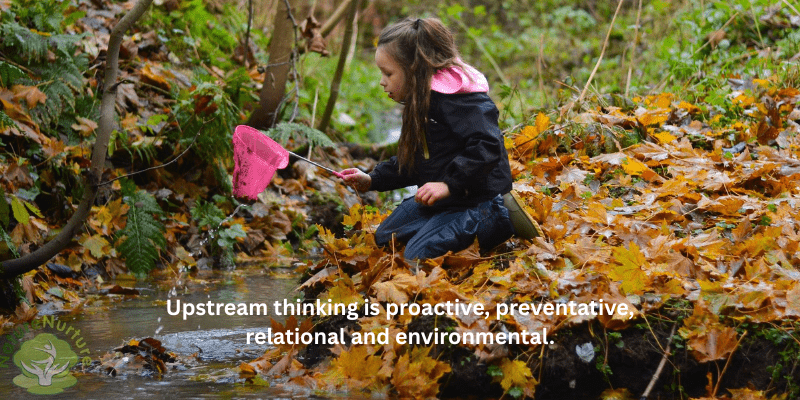
Upstream thinking is proactive, preventative, relational and environmental.
Callum, like many children, would likely have benefited from daily access to movement, outdoor learning and regular brain breaks. A classroom rhythm that included opportunities to move, regulate and reset would not only have supported him. It would probably have benefited a large proportion of the class. An environment that anticipated the need for sensory support and active learning might have prevented much of the frustration and dysregulation from building in the first place.
Sam would also have benefited from a school experience that reduced the emotional cliff edge of the school day. Gentle outside time at the start of the day, opportunities to move, quieter spaces, emotionally attuned adults and a gradual rebuilding of belonging might have offered a more compassionate bridge back into school life. Her distress was not solved by pressure. It would more likely have eased through safety, relationship and manageable connection.
Before their difficulties became entrenched, both children would have benefited from relational pedagogy that supported self-regulation through co-regulation, emotional attunement and emotion coaching. In truth, there is not one child in school who would not benefit from nurturing, predictable routines and adults who understand that behaviour is communication.
Nature Nurture as an Upstream Approach
This is why I believe the Nature Nurture Approach is an upstream approach.
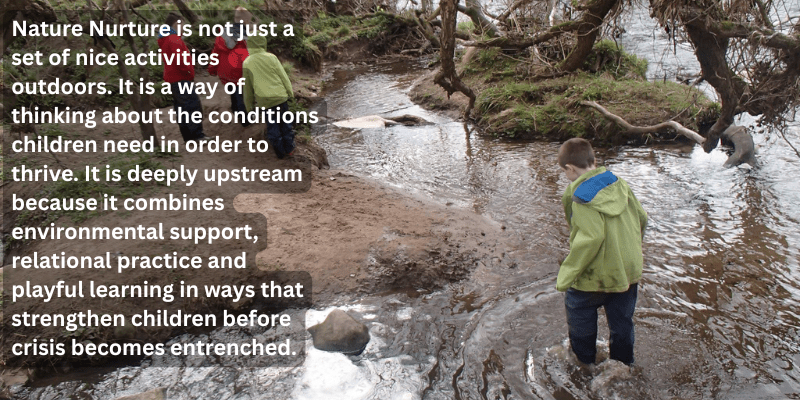
When whole classes or groups have daily time outside to learn, play, move and connect with natural environments, supported by attuned adults, we are doing far more than providing a pleasant activity. We are embedding proactive, preventative and health promoting foundations for children’s wellbeing and learning.
At the heart of the Nature Nurture Approach is a simple formula:
Nature + Nurture + Play = Resilience
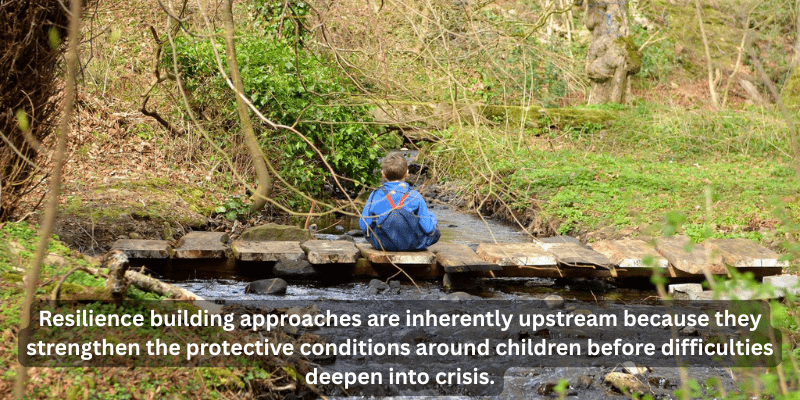
Resilience building approaches are inherently upstream because they strengthen the protective conditions around children before difficulties deepen into crisis.
Access to nature can soothe stress and support regulation. It can reduce anxiety, improve mood, increase attention and help children sustain concentration. This matters enormously for children like Callum, whose nervous systems may be crying out for movement, sensory input and a less restrictive learning environment.
Nature can also support social and emotional development. Natural spaces offer opportunities for cooperation, collaboration, imagination and shared problem solving. For children like Sam, that can make a real difference. A growing sense of belonging to a group, built gently through shared experiences outdoors, can begin to loosen the grip of anxiety and disconnection.
The nurture element of our formula is about relationships. Adults who facilitate Nature Nurture are focused from the start on knowing the child deeply. They notice strengths, interests and talents, but they are also attuned to fears, patterns of distress and emotional weather. Through consistent, compassionate connection, they help children develop self-regulation through the lived experience of co-regulation. A relationship that becomes a secure base can be transformative.
The play element matters just as much. Play and curiosity are not extras. They are central vehicles for development and learning. Active, experiential, playful learning outdoors can ignite motivation, creativity and engagement. It can create a level playing field where many children who struggle in more formal classroom contexts discover competence, joy and belonging.
This is upstream work because it changes the conditions that shape children’s daily experience of school.
Nature Nurture in Practice as Early Intervention
Nature Nurture in Practice is our targeted intervention programme for children who are already struggling, either at home or at school. It is not fully upstream, because it is designed for children who are already showing distress. However, it still sits much further upstream than many crises driven or punitive responses.
Nature Nurture in Practice offers children understanding, connection and support before their difficulties deepen further. It aims to build self-belief, confidence, growth mindset and awareness of personal strengths. Through compassionate relationships, time in nature and child led playful experiences, children are given the conditions to recover, reconnect and develop tools for navigating challenge.
This kind of early intervention can change trajectories. It can support children before they are caught in more destructive downstream patterns such as exclusion, severe disengagement, chronic absence or long-term emotional crisis.
The Financial Case for Upstream Investment
When I raise the idea of upstream intervention with stressed and overwhelmed school leaders, I am sometimes met with understandable responses such as, “It is too expensive,” or “We do not have the budget.”
But upstream work is not an added luxury. It is a cost saving strategy.
The financial case is clear. Reactive interventions such as exclusions, specialist placements, high levels of crisis management, individualised support at the point of breakdown, and involvement from multiple services are costly. They are costly in money, but also in time, emotional energy and long-term impact.
By contrast, preventative approaches such as staff training, emotionally informed practice, outdoor learning, movement rich routines and universal wellbeing provision can reduce the escalation that leads to those heavier costs later.
Early intervention can prevent problems from becoming more severe and reduce the need for expensive reactive responses. The further downstream we intervene, the higher the human and financial cost usually becomes.
This is not just a budget issue. It is a human and moral one too. Investing earlier means reducing suffering later.
What Research Tells Us
Across research in education, child development, mental health and wellbeing, the message is remarkably consistent. When we act early by reducing stress, strengthening relationships and creating environments where children feel safe, connected and included, we improve wellbeing and learning and we reduce the need for more expensive reactive intervention later.
The human case is compelling. Chronic stress affects development, regulation and learning.
The moral case is compelling. Waiting for crisis often means the most vulnerable children carry the greatest burden.
The financial case is compelling. Prevention and early intervention cost less than crisis and repair.
All three point in the same direction.
We need to stand further upstream.
Conclusion
We will always need people downstream. There will always be children in immediate distress who need urgent support, care and rescue.
But what if more of us stood further upstream, shaping school environments, routines, relationships and learning experiences so that fewer children were swept into the current in the first place?
Upstream approaches benefit everyone. They create healthier, kinder, more inclusive school communities. They reduce preventable distress. They strengthen belonging and engagement. And they remind us that the earlier we act, the less we need to fix later.
Further Reading and Research
If you would like to explore these ideas further, Dan Heath’s Upstream offers an excellent starting point for thinking about prevention and systems change. For the impact of stress and trauma on children’s development, Bruce Perry’s The Boy Who Was Raised as a Dog remains highly influential. For the role of nature and movement in children’s wellbeing and learning, Angela Hanscom’s Balanced and Barefoot, Richard Louv’s Last Child in the Woods, and Florence William’s The Nature Fix are all valuable.
Reports from the Children’s Commissioner for England, (https://www.childrenscommissioner.gov.uk/resource/childrens-mental-health-services-2023-24/) (https://assets.childrenscommissioner.gov.uk/wpuploads/2024/03/Childrens-mental-health-services-22-23_CCo-final-report.pdf)
the Children’s Society (https://www.childrenssociety.org.uk/sites/default/files/2024-08/Good%20Childhood%20Report-Main-Report.pdf ),
and the Centre for Mental Health (https://www.centreformentalhealth.org.uk/wp-content/uploads/2026/01/Future-Minds-Report-2026-D4.pdf )
also offer important insight into belonging, crisis support, early intervention and the long-term case for investing earlier in children’s lives.