

Over the past 15 years of Nature Nurture practice, we have welcomed many children into our sessions who arrive overwhelmed, overstimulated, or dysregulated — both physically and emotionally. Others come to us flat and disconnected, lacking energy, motivation, or a sense of engagement. Some are constantly on the move — spinning, crashing, touching — seeking the sensory input their bodies need to feel organised and well.
These are not isolated experiences. They are children whose sensory needs are simply not being met in busy, indoor environments.
And yet, time and again, we watch these same children settle, connect, and begin to thrive when they are given access to natural outdoor spaces, supported by attuned adults, and offered time and freedom to lead their own play and learning.
It raises an important question: What is the mechanism that makes this work?
🌱 What is Sensory Integration?
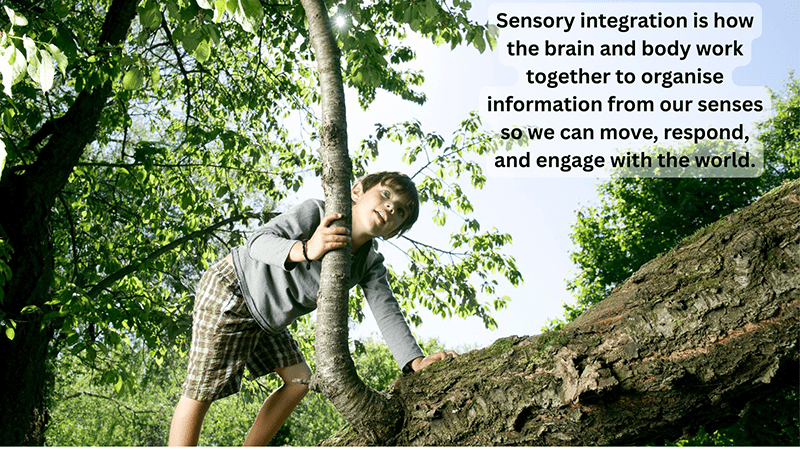
When we talk about sensory integration, we are talking about far more than the five senses we learned about in school. Children experience the world — and their own bodies — through a rich and complex sensory system that includes not only sight, hearing, smell, taste, and touch, but also the vestibular system (movement and balance), proprioception (body and pressure awareness), and interoception (internal body signals).
These sensory systems act as the body’s way of gathering information, helping children to feel connected, safe, and ready to engage with the world around them.
When sensory processing is well organised, children can regulate their emotions, coordinate their movements, and participate in learning and relationships with increasing confidence. But when this finely tuned system is out of balance, children may experience the world as overwhelming, confusing, or under-stimulating.
Some children become hypersensitive — distressed by noise, touch, or movement — while others may be hyposensitive, seeking out more intense sensory input to feel alert and organised. What can sometimes be interpreted as “challenging behaviour” is often a child’s attempt to make sense of or regulate their sensory world.
As Carol Kranowitz reminds us:
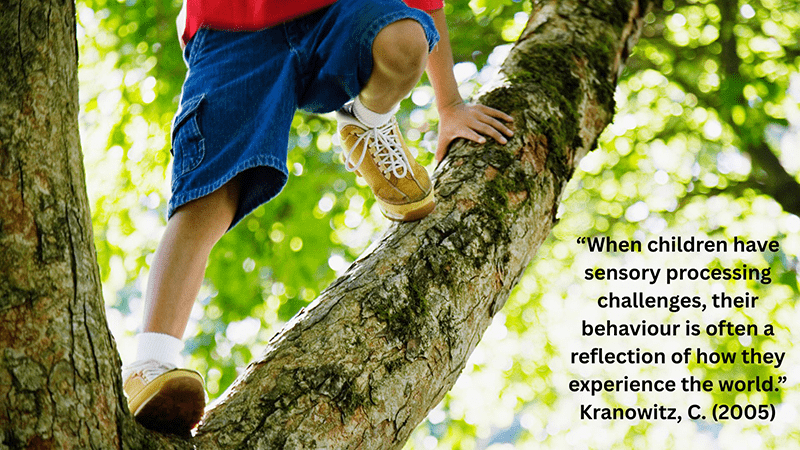
“When children have sensory processing challenges, their behaviour is often a reflection of how they experience the world.”
🌿 Nature: The Optimal Sensory Environment
Nature offers something that no indoor environment can fully replicate — a sensory experience that is both richly stimulating and inherently regulating.
In natural spaces, children encounter uneven ground, shifting weather, varied textures, open space, and constantly changing sensory input. These experiences gently and continuously engage the vestibular, proprioceptive, and tactile systems in ways that are difficult to recreate indoors.
Angela Hanscom captures this beautifully:
“Children need strong sensory experiences to develop properly. Nature provides that in the richest possible way.”
And yet, despite this richness, nature rarely overwhelms. Instead, it seems to support the nervous system to settle and organise itself.
Florence Williams writes:
“Nature quiets the mind and restores the brain in ways we are only beginning to understand.”
Similarly, Eva Selhub highlights the impact of natural environments on stress and resilience:
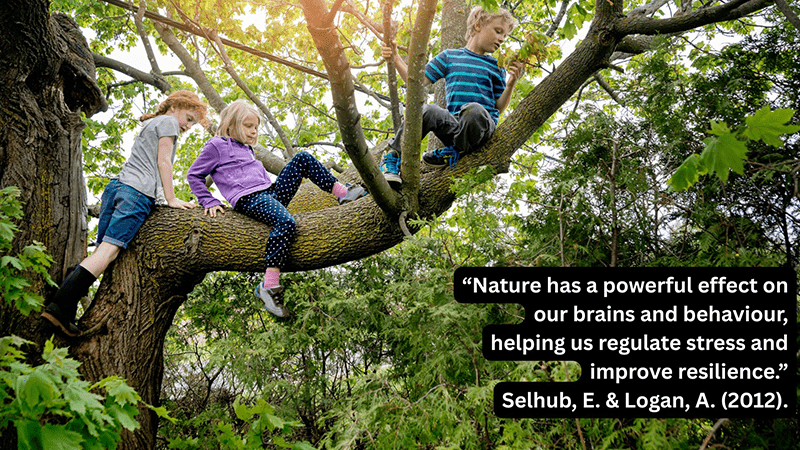
“Nature has a powerful effect on our brains and behaviour, helping us regulate stress and improve resilience.”
What we see in practice aligns closely with this research. Children who arrive in a heightened state — ready to fight, flee, or freeze — often begin to downshift in nature. Their bodies soften, their attention widens, and they become more available for connection, play, and learning.
Nature does not overwhelm — it organises. It offers sensory input that is varied but not chaotic, stimulating but not dysregulating.
🤝 Nurture: The Foundation for Integration
While nature provides the sensory input, it is nurturing relationships that make that input feel safe enough to process.
Sensory integration is not purely physical — it is deeply relational. Children are far more able to engage with sensory experiences when they feel emotionally secure, understood, and supported.
Kathy Willis reminds us:
“The brain is shaped by experiences — and especially by emotional experiences.”
An attuned adult plays a vital role here. By noticing, interpreting, and responding sensitively, adults help children make sense of what they are experiencing. They offer co-regulation through calm presence and thoughtful responses, and they gently scaffold experiences so that children can engage at a pace that feels manageable.
In this way, nurture creates the felt safety that allows the nervous system to receive, process, and integrate sensory input, rather than becoming overwhelmed by it.
🎨 Play: The Engine of Sensory Integration
If nature provides the input and nurture provides the safety, then play is where sensory integration truly happens.
Through child-led, embodied play, children instinctively seek out the sensory experiences their bodies need. They repeat actions, refine movements, test limits, and build understanding through direct, physical engagement with the world.
As Kranowitz explains:
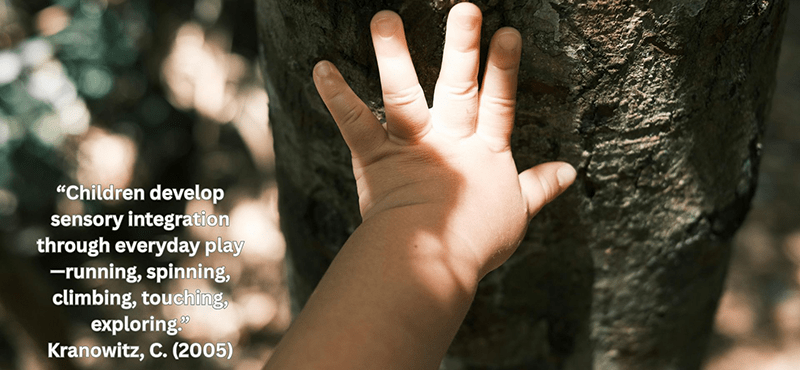
“Children develop sensory integration through everyday play — running, spinning, climbing, touching, exploring.”
Angela Hanscom also emphasises the central role of movement:
“Movement is essential for learning. When children move, they wire their brains.”
In this sense, play can be understood as a form of self-directed therapy. It allows children to calibrate their sensory systems, develop body awareness, and build confidence through manageable risk and exploration.
This kind of play cannot be rushed or overly directed. It depends on children having time, space, and permission to follow their own ideas and needs.
🌿 Bringing It All Together
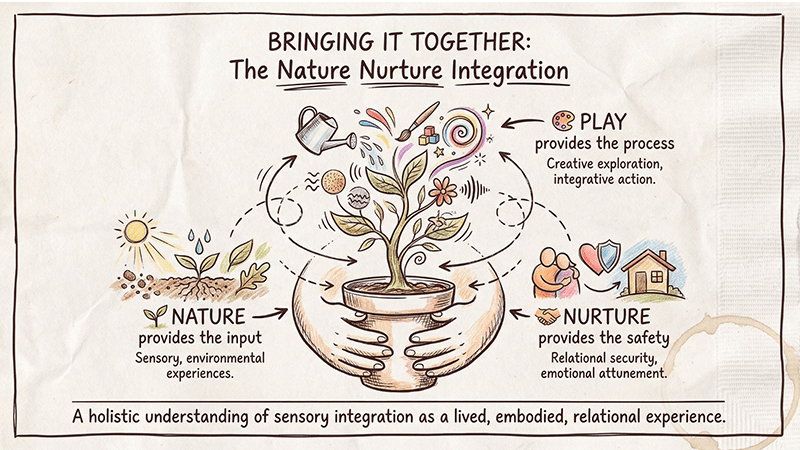
When nature, nurture, and play come together, the conditions for sensory integration are naturally created.
Nature offers the rich sensory input that children need. Nurture provides the emotional safety that allows that input to be processed. Play gives children the means to explore, repeat, and integrate these experiences in meaningful ways.
Within this combination, we begin to see children regulate their sensory systems more effectively. They become more at ease in their bodies, more able to engage with others, and more open to learning.
For many neurodivergent children, including those with autism and ADHD, these conditions can be particularly powerful. Access to outdoor environments and opportunities for movement and play can support attention, reduce stress responses, and promote more balanced sensory processing.
🌿 A Shift in Perspective
Perhaps the most important shift is in how we frame the challenge.
Rather than asking, “How do we fix children’s sensory needs?” we might instead ask, “How do we create the conditions in which children’s sensory systems can organise themselves?”
The Nature Nurture approach offers a compelling answer.
Through daily outdoor experiences, nurturing relationships, and protected time for play, children are not required to adapt to an environment that does not meet their needs. Instead, the environment adapts to them.
And in doing so, we see something powerful emerge:
Children don’t just cope — they integrate, regulate, and truly thrive.
📚 Further Reading and Research
If you would like to explore this area further, the following authors and resources provide valuable insights into sensory integration, nature, and child development:
Books
- Kranowitz, C. (2005). The Out-of-Sync Child. Perigee.
- Hanscom, A. (2016). Balanced and Barefoot. New Harbinger.
- Williams, F. (2017). The Nature Fix. W.W. Norton.
- Selhub, E. & Logan, A. (2012). Your Brain on Nature. Wiley.
- Willis, J. (2006). Research-Based Strategies to Ignite Student Learning. ASCD.
Online Resources
- Children & Nature Network – https://www.childrenandnature.org
- Sensory Integration Education – https://www.sensoryintegrationeducation.com
- Mind (Children & Young People) – https://www.mind.org.uk
- STAR Institute for Sensory Processing – https://www.spdstar.org
More about Nature Nurture…