

Introduction
Language and communication development can be challenging for many children who are referred to Nature Nurture interventions or participate in groups where the Nature Nurture Approach is embedded. Many experience additional support needs that create barriers to expressive and receptive language and communication.
While it is easy to recognise how natural environments can support emotional regulation, wellbeing, and focus, it may be less obvious how time spent outdoors can support the development of language and communication.
However, emerging research increasingly suggests that outdoor learning environments provide authentic, meaningful and multisensory experiences that support both receptive and expressive language and communication development.
When we look closely at Nature Nurture practice, we can see that language development is supported in four interconnected ways:
- Having something to talk about
- Having someone to talk to
- Being able to move freely
- Being in nature
Children experience a wide range of communication challenges. These may include being non-verbal or pre-verbal, selective mutism, speech sound or fluency difficulties, developmental language disorder, or language processing difficulties affecting receptive and expressive language.
Communication challenges are often part of wider additional support needs including autism, ADHD, learning disability, anxiety, trauma, Down’s syndrome, cerebral palsy, and sensory impairments such as hearing loss.
A growing body of research identifies several key through-lines in the literature: natural environments can increase children’s motivation to communicate, support the development of pragmatic communication skills such as negotiating and explaining, and build vocabulary and conceptual knowledge that underpin later literacy development.
Having Something to Talk About
Natural environments create what researchers describe as high-affordance environments. In simple terms, they offer open-ended opportunities for exploration and play.
Unlike many indoor learning spaces where materials have fixed purposes, nature offers constantly changing possibilities. These open environments naturally generate moments where children need to communicate:
- asking questions (‘What is it?’ ‘Why?’)
- coordinating plans (‘Let’s build a den’)
- negotiating roles and rules (‘You collect the sticks, I’ll build the wall’)
- describing sensory experiences (wet, rough, brittle, heavy, slippery)
These communicative demands arise organically through play rather than through adult instruction.
Natural materials also support the transition from concrete to symbolic thinking. A stick might become a spoon, a horse, a thermometer, or a magic wand. This form of identity play requires the child to hold a symbolic idea in their mind and communicate it to others.
Nature also expands vocabulary. Unlike fixed toys, natural materials require children to use descriptive language to navigate their environment: rough, smooth, damp, brittle, light, heavy.
Outdoor play is often richly narrative. Children invent stories, construct imaginary worlds, and sequence events in their play. These storytelling processes develop the language structures needed for later literacy.
Moments of discovery — a sparkling frost on a leaf or a beetle under a log — also create powerful opportunities for joint attention, where adults and children share focus on the same experience.
Having Someone to Talk To
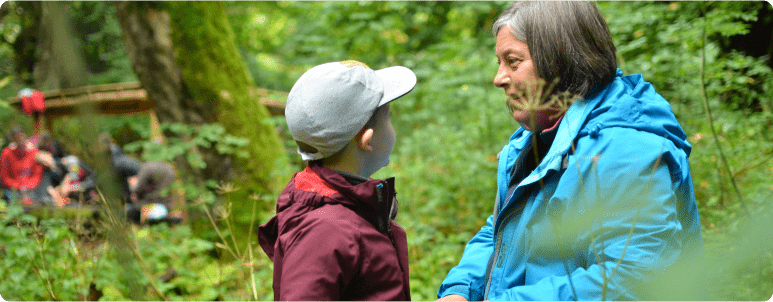
Language development is fundamentally relational. Children learn language through responsive interaction with attuned adults and peers.
Researchers at the Center on the Developing Child at Harvard University describe early communication as ‘serve and return’ interactions — responsive back-and-forth exchanges between adult and child that build both language and brain architecture.
Natural environments may make these interactions easier to sustain.
Research by Thea Cameron-Faulkner and colleagues found that children were more talkative outdoors, and that parent–child conversations in natural environments were more connected and responsive than conversations indoors.
In Nature Nurture practice, one of the most powerful communication tools is the simple ‘walk and talk.’ Walking side-by-side reduces social pressure and often allows children to express their thoughts more freely.
Being Able to Move Freely
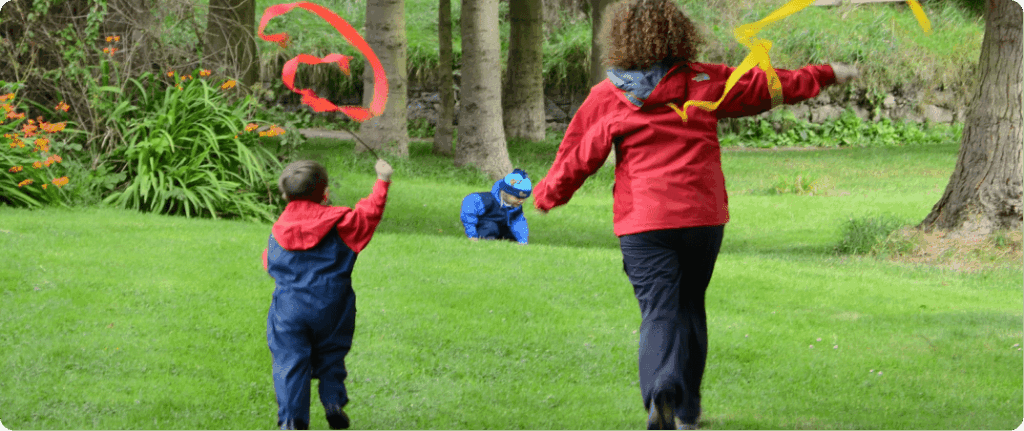
Movement and language are closely connected. Outdoor environments expand children’s opportunities for physical action — climbing, digging, balancing, hauling, building and exploring. These physical experiences create natural situations where children must communicate intentions, request help, negotiate turn-taking, or describe plans.
Movement also supports communication through gesture and embodied language. Gesture is a foundational communication system in early childhood and continues to support expressive language throughout life.
In many Nature Nurture sessions, children’s storytelling, planning and explanations are accompanied by animated gesture, rhythm and physical action.
Behaviour as the First Language
A key principle in supporting communication development is recognising that all behaviour communicates something.
Children who do not yet have the language to describe their internal experiences — frustration, anxiety, curiosity, excitement — may communicate through behaviour.
Nature Nurture practitioners interpret behaviour as a communication signal and respond with calm, supportive language that helps children connect feelings with words.
Shared Neural Systems for Movement and Language
Neuroscience highlights important links between movement and language.
Motor planning and language processing involve overlapping brain regions, including Broca’s area and the cerebellum.
The mirror neuron system further connects these domains, supporting imitation and shared learning.
How Nature Nurture Supports Language and Communication Development
Whether Nature Nurture is experienced as a targeted intervention or as a whole-class approach, evidence suggests that language and communication flourish when children spend time outdoors with attuned adults and opportunities for meaningful play and movement.
Language grows when children feel emotionally safe, engaged in meaningful activity, share attention with responsive adults, and experience sustained back-and-forth interaction.
In Nature Nurture practice, the environment becomes the third partner in the learning relationship between adult and child.
Further Reading and Research
Richardson et al. (2023). How does nature support early language learning? A systematic literature review.
Cameron-Faulkner et al. (2018). Responding to nature: Natural environments improve parent–child communication.
Angela Hanscom – Balanced and Barefoot
Jan White – Playing and Learning Outdoors
Richard Louv – Last Child in the Woods
Peter Gray – Free to Learn
Stuart Shanker – Self-Reg
Harvard Center on the Developing Child: https://developingchild.harvard.edu
Richardson et al. (2023) systematic review: https://nectar.northampton.ac.uk/id/eprint/20096/
Cameron-Faulkner research: https://www.sciencedirect.com/science/article/pii/S0272494418301178