

Do you ever carry that quiet, nagging feeling that you’re not taking your children outside enough?
There’s a strong and welcome push for more outdoor learning. We know it matters. But inside, things can feel more contained. More predictable. More manageable. Outside, everything shifts – the space, the risks, the unknowns, especially when the weather turns or the day isn’t going to plan.
Or perhaps you’ve already stepped outside with your group, and one child is dysregulated from the outset. Their behaviour suggests they might run, withdraw, or escalate at any moment. That sudden surge of “what do I do now?” can feel overwhelming. The weight of responsibility presses in and in that moment, it can feel like you’re completely on your own.
If any of this feels familiar, you are not alone.
I write this because I have felt it too, many times. And I have heard countless practitioners and teachers share the same feelings when given the space to do so.
But here is something important to hold onto:
Professional anxiety is not a weakness. It is a sign that you care deeply and take your responsibility seriously.
What Does Professional Confidence Really Look Like?
When practitioners talk about confidence, they often say: “I just wish I felt more certain in what I’m doing.”
But confidence is not certainty.
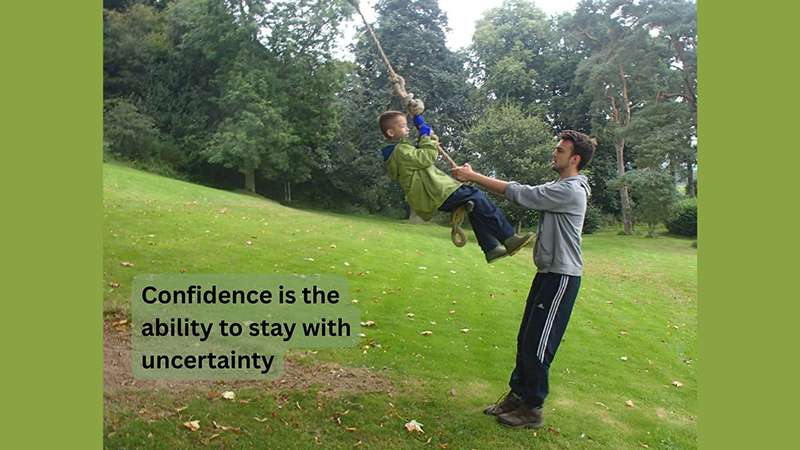
Confidence is the ability to stay with uncertainty. To ride it. To respond and adapt in the moment.
During my time at Camphill, one of the founding ideas was that practitioners need to become dancers. Not performers with a fixed routine, but responsive partners — attuning to the rhythm, pace and emotional tone of the child or group in front of them. Staying in step. Adjusting as the music changes.
That kind of practice rarely comes from certainty.
It comes from responsiveness.
It is not true that confident professionals always know what to do.
But they do know how to respond, reflect, and adjust.
Another common misconception is that confidence means control.
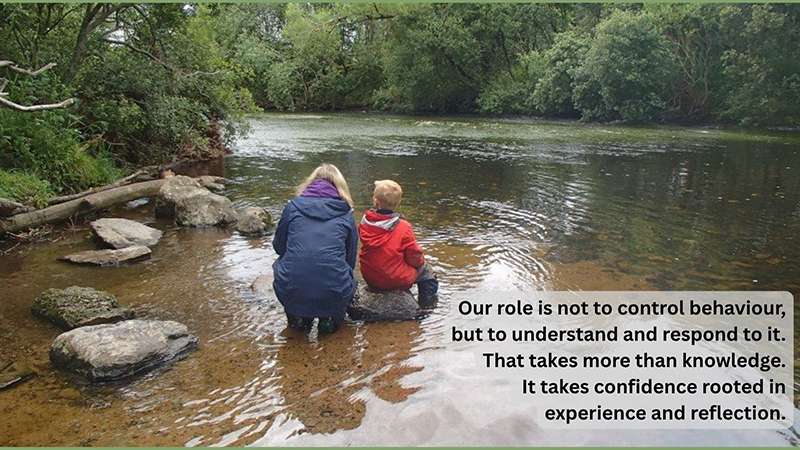
Some of the most effective practice happens when we loosen control. When we trust children’s natural drives to explore, play and learn. When we move from directing learning to facilitating it.
So, confidence is not about control. It is about connection and responsiveness.
And finally, confidence is not something you either have, or you don’t. No one becomes confident in isolation.
Professional Confidence grows through:
- support
- reflection
- shared thinking
- and the opportunity to repair and try again
Having a trusted colleague, mentor or “critical friend” to explore situations with can be transformative. Again, confidence is rooted in connection.
Why Professional Confidence Can Feel So Fragile
This is not about a lack of professional skill. Every practitioner reading this has already demonstrated knowledge, care and capability.
More often, a crisis of confidence stems from a lack of the right kind of support.
Most groups include children who are navigating trauma, anxiety, or additional support needs. These experiences can present in ways that are unpredictable, complex and emotionally charged.
Research from Bruce D. Perry highlights how trauma responses are rooted in the nervous system and are often reactive rather than rational. This means our responses as adults need to prioritise safety, trust, choice, collaboration and empowerment.
That is not easy work, especially without space to think it through with others.
Outdoor environments add further layers:
- changing conditions
- open spaces
- increased movement and freedom
- real and perceived risk
Even experienced practitioners benefit from shared planning and reflective evaluation in this context.
Then there is the social pressure, sometimes spoken, often unspoken:
- fear of judgement from colleagues or parents
- accountability for safety
- organisational expectations
All of this can quietly shape how confident we feel.
The Cost of Low Professional Confidence
When confidence remains low over time, the impact can be significant. For teachers and practitioners, it can look like increased stress and anxiety, or avoidance of outdoor learning sessions with their group. It can lead to burnout or stress related illness. Or it sometimes results in over-controlling or risk-averse practice.
What is the impact of low professional confidence on children? It might mean fewer opportunities to spend time in outside in nature. This is important for so many reasons not least that nature can help soothe and regulate big emotions or stress. Less opportunity to be outside can mean reduced autonomy and meaningful play. It can also result in fewer chances to build, maintain and repair relationships.
And this matters.
There is a growing body of research showing the profound impact of nature on children’s wellbeing. Authors such as Angela Hanscom and Florence Williams highlight the role of movement, sensory experience and outdoor environments in supporting emotional regulation and development.
If professional confidence becomes a barrier to this, it is something we must take seriously.
Reframing Confidence: It Can Be Grown
There is good news.
Confidence is not something you need before you begin. It is something that grows through supported practice.
Research into professional learning consistently shows that meaningful development comes from:
- experience followed by reflection
- ongoing professional dialogue
- safe spaces to ask questions and not have all the answers
- collaborative enquiry with peers
The work of Helen Timperley and Dylan Wiliam emphasises that sustained, collaborative professional learning has far greater impact than one-off training.
Perhaps most importantly, confidence grows when practitioners begin to see the impact of their work over time.
When you notice a child beginning to regulate more easily…
When relationships strengthen…
When engagement returns…
That is where confidence takes root.
Confidence is not a prerequisite for practice. It is an outcome of supported practice.
🌿 Three Pathways to Building Professional Confidence
Over the past 15 years, the Nature Nurture Approach has grown in response to a very consistent message from teachers and practitioners: “I don’t just need more ideas — I need to feel more confident in what I’m doing.”
Professional confidence does not grow from information alone. It grows from understanding, from trying things out, from reflecting on what happens, and from having the right kind of support around you.
These three professional development pathways have been designed to meet professionals at different points in that journey. Each one offers something slightly different, and together they create a supportive, connected route into more confident, responsive practice.
🌱 Nature Nurture Approach – a self-paced online course on incorporating nature, nurture and play into your daily practice.
For many professionals, the starting point is a desire to better understand what sits underneath their day-to-day experiences. It is designed for professionals facilitating the learning and wellbeing of groups or whole classes and its emphasis is on delivering universal support for all children.
You might recognise moments where something doesn’t feel quite right where a child is struggling, or where outdoor learning feels harder than it “should”, but you are not entirely sure how to respond differently. This is where building knowledge and clarity can make a real difference.
The Nature Nurture Approach course offers a structured but flexible way to develop that understanding. It explores how children grow and develop, how relationships support emotional regulation, and how outdoor environments can be used intentionally to support wellbeing and learning.
What makes this pathway particularly supportive is the way it connects theory directly to practice. Rather than learning in isolation, you are encouraged to take small, manageable ideas into your own setting, notice what happens, and reflect on the experience. Over time, this begins to shift how you see children, how you interpret behaviour, and how you make decisions in the moment.
Because the course is self-paced, it allows space to revisit ideas and move at a rhythm that works alongside the realities of your role. Many practitioners find that this gentle, steady approach helps them feel more grounded and reassured in their practice.
Through this pathway, confidence begins to grow from a place of understanding. You move from questioning yourself to having a clearer sense of why you are doing what you are doing — and that clarity creates a strong foundation for confident practice.
🌿 Nature Nurture in Practice – an online course combined with group coaching, featuring weekly one-hour live sessions with a tutor and a connected community of peers.
For practitioners working closely with individual or small groups of children who have additional support needs, trauma experiences, or social and emotional challenges, confidence often needs more than understanding.
It needs space to think, to talk, and to be supported through real situations.
Nature Nurture in Practice has been developed with this in mind. It is a live, supported programme that brings together a small group of practitioners on a shared journey. Each week, participants meet online to explore ideas, reflect on their experiences, and learn from one another in a safe and respectful space. Each week of the three-month programme covers a unit of the online course. The sessions are delivered in person, with full access to each unit and companion resources accessible in the Nature Nurture in Practice area on our website.
What often makes the biggest difference here is the sense of connection. Practitioners quickly realise they are not the only ones facing uncertainty, and that can be hugely relieving. Through guided discussion, coaching and shared reflection, situations that once felt overwhelming begin to feel more manageable and more understandable.
Between sessions, participants take their learning back into their own settings. They try things out in practice, observe how children respond, and return to the group with real experiences to reflect on. This ongoing cycle of action and reflection allows learning to become embedded, rather than remaining theoretical.
Over time, practitioners often notice a shift. Situations that once triggered anxiety begin to feel more familiar. There is a growing ability to pause, to interpret what might be happening beneath behaviour, and to respond in a way that supports the child while also feeling manageable for the adult.
Professional confidence, in this context, does not come from having all the answers. It comes from knowing that you can stay with the situation, think it through, and respond in a way that is thoughtful and informed.
This pathway supports a deeper transformation — from feeling unsure and under pressure to feeling more capable, connected and confident in your professional judgement.
🍃 Nature Nurture & ASN Substack – Ongoing Professional Nourishment
Even when confidence begins to grow, it needs to be sustained.
Many practitioners describe how easy it is to slip back into doubt when working in isolation or under pressure. Without regular opportunities to reflect and reconnect with their thinking, it can feel as though they are carrying everything on their own.
The Nature Nurture and ASN Substack has been created to offer ongoing support in a way that fits into busy professional lives. Through weekly posts, it provides a gentle but consistent space for reflection, bringing together research, lived experience and practical insight.
Rather than presenting fixed answers, the blog invites you to pause and consider your own practice. It offers new perspectives, affirms what you may already be doing well, and introduces small shifts in thinking that can have a meaningful impact over time.
For many practitioners, this becomes a valuable anchor point, something they return to regularly to feel reconnected, reassured and inspired. It helps maintain momentum, especially after training or periods of professional learning, ensuring that professional confidence continues to develop rather than fade.
Importantly, it also helps reduce the sense of isolation that can come with this work. Through shared language, shared experiences and a consistent flow of ideas, practitioners begin to feel part of something bigger, a community of people working thoughtfully and reflectively to support children.
Through this pathway, confidence is not only built but sustained. It becomes something that is continually nurtured, rather than something that needs to be constantly regained.
🔄 A Joined-Up Model of Growth
Each of these pathways offers value. However, when experienced together, they create a coherent and supportive journey of professional development.
You might begin by building your understanding through the self-paced course.
You may then deepen your practice through the live, supported programme.
And alongside this, you can sustain your thinking and reflection through the Substack.
Professional confidence does not emerge from a single moment of learning. It grows over time, through experience, reflection and connection.
These pathways are designed to support that process, helping you move, step by step, from doubt to direction in your practice.
Final Reflection: Permission to ‘Be in Progress’
Confidence is not a destination.
It is an ongoing process of adapting, responding and learning.
Children do not need perfection from us. They need presence, curiosity and commitment.
The most impactful practitioners are those who:
- reflect
- stay curious
- seek support
So perhaps the question is not: “How do I become more confident?”
But instead: “What would become possible in my practice if I felt more supported?”
📚 Further Reading & Professional Learning
Online Articles & Guidance
- Education Scotland – Professional Learning
https://education.gov.scot/professional-learning/
- Centre for Mental Health
https://www.centreformentalhealth.org.uk
- The Children’s Society
https://www.childrenssociety.org.uk
Books & Research
- The Boy Who Was Raised as a Dog – Bruce D. Perry
- The Body Keeps the Score – Bessel van der Kolk
- Balanced and Barefoot – Angela Hanscom
- The Nature Fix – Florence Williams
Professional Learning & Confidence
- Thomas Guskey (2002) – Evaluating professional development
- Helen Timperley (2008) – Teacher professional learning
- Dylan Wiliam – Sustained professional growth