
- customer-service@salugen.uk
- +44 (0) 7948-972550
SKU: NNWRGe
£7.99 inc. VAT
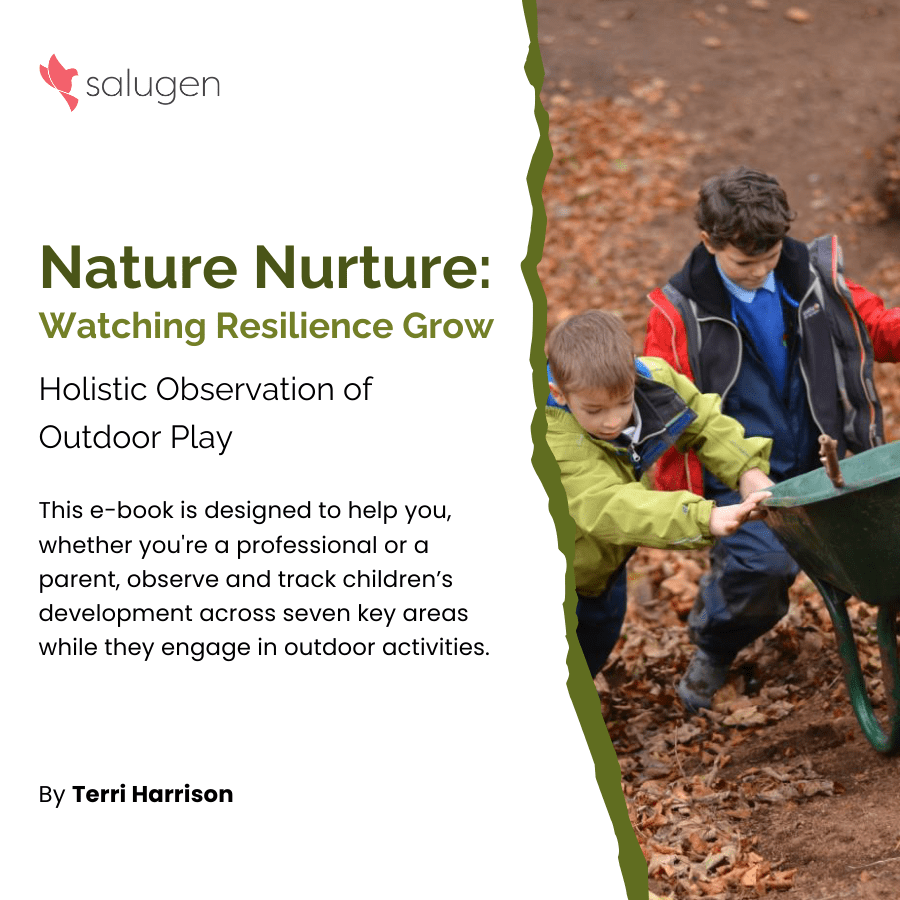
Watching Resilience Grow is a practical, compassionate eBook designed to introduce you to the 7 Domains of Resilience that shape the Nature Nurture approach. Whether you’re an educator, parent, carer or practitioner, this guide helps you understand how resilience develops and how everyday interactions – especially those rooted in nature, relationships and attuned practice – can support children to flourish.
This eBook provides a clear and accessible framework for watching resilience grow across seven interconnected developmental domains. Each domain reflects a vital aspect of child wellbeing and offers simple, thoughtful ways to strengthen emotional health, social connection and lifelong confidence.
The Nature Nurture approach recognises resilience as something that grows gradually, through accumulated experiences of safety, connection, exploration and meaning. This eBook walks you through each domain with practical examples, reflective insights and guidance you can use immediately in your setting.
Below are the seven domains presented in the eBook:
This domain explains how children learn to understand and manage their feelings. You’ll explore the importance of co‑regulation, emotional vocabulary and soothing environments. Nature plays a powerful role here: fresh air, sensory experiences and open space provide natural regulation cues. As children feel understood and supported, you’ll find yourself steadily watching resilience grow in their emotional responses, confidence and ability to self‑soothe.
Healthy relationships underpin every aspect of resilience. This domain highlights how trust, empathy, communication and cooperation are nurtured through playful connection and consistent adult presence. Outdoor and group activities create natural opportunities for teamwork and belonging. As social skills strengthen, you’ll be watching resilience grow through improved friendships, reduced conflict and more secure peer relationships.
Physical wellbeing forms the foundation for emotional regulation and cognitive development. This section explores how movement, sensory integration and healthy physical risk contribute to strength and confidence. By supporting children to climb, balance, run, dig or explore, you’re not only promoting health – you’re actively watching resilience grow through physical mastery and body awareness.
Resilience flourishes when a child’s strengths are recognised and celebrated. This domain helps you identify children’s unique talents and passions – whether creative, analytical, physical or relational. By nurturing and expanding these interests, you’ll see children developing self‑esteem and intrinsic motivation. This is one of the clearest moments of watching resilience grow, as children express pride in what they can do.
Children become more resilient when they internalise kindness, fairness, honesty and responsibility. This domain focuses on modelling positive values, using restorative language and creating opportunities for children to contribute meaningfully. As children begin acting from values rather than impulse, you are watching resilience grow in the form of thoughtful choices and compassionate behaviour.
Creativity helps children make sense of the world and express ideas that may be difficult to articulate in words. The Nature Nurture approach encourages imaginative play, storytelling, nature‑inspired art and open‑ended exploration. These experiences nurture flexible thinking, emotional expression and problem‑solving. With every imaginative leap, you are watching resilience grow through curiosity and creativity.
Resilience grows as children build confidence in their ability to understand, question and interpret the world around them. This domain explores experiential learning, inquiry, reflective dialogue and hands‑on discovery. Outdoor environments provide natural opportunities for learning through real experiences, helping you continually watch resilience grow as knowledge deepens and understanding expands.
Across all seven domains, Watching Resilience Grow offers simple yet powerful insights grounded in the Nature Nurture approach. By combining relational practice, nature‑based learning and reflective thinking, the framework empowers you to create environments where children feel safe, valued and capable.
Whether you are supporting a new class, guiding individual pupils or working in family or community settings, this eBook helps you recognise the subtle, meaningful signs of progress that show you are truly watching resilience grow – step by step, moment by moment.
Citation: Gartland, D., Riggs, E., Muyeen, S., Giallo, R., Afifi, T., MacMillan, H., Herrman, H., Bulford, E., & Brown, S. (2019). What factors are associated with resilient outcomes in children exposed to social adversity? A systematic review. BMJ Open, 9(4). 🔗 https://bmjopen.bmj.com/content/9/4/e024870
Why it’s relevant:
This is one of the most authoritative UK‑published systematic reviews available and highly suitable for educational, wellbeing or therapeutic contexts.
Citation: Williams‑Brown, Z., Daly, J., Jopling, M., & Aston, A. (2020). What does resilience mean to children? In Z. Williams‑Brown & S. Mander (Eds.), Childhood Wellbeing and Resilience: Influences on Educational Outcomes. Routledge. 🔗 https://doi.org/10.4324/9780429324635
Why it’s relevant:
You may also be interested in our related courses: